Yogic Perspective: Death, Void-Walking & Reincarnation or Liberation
On the Realization of Sunya (Void) and Atman (Self) at the Threshold of Death

The real crisis of modern spirituality isn’t that people don’t know how to meditate. It’s that most of them don’t know how to die.
When I was seventeen, I slipped into death’s shadow for the first time. A reckless move on a rock face—a moment of adolescent bravado—sent me into a fall that tore consciousness loose from the body. What followed was not fear but a clarity beyond anything I had ever imagined: the unmistakable sensation of the soul stepping outside its vessel; the world dissolving into a field of light, consciousness, and an overwhelming, all-pervasive love; a brief but searing glimpse into the Bardos themselves.
That encounter convinced me that The Tibetan Book of Living and Dying (as well as modern books like Dream Yoga) are not merely literature, but one of the most important guides ever written on the architecture of existence. It also sharpened my perception for what follows—an analysis shaped not only by study, but by direct brush with the threshold it seeks to describe.
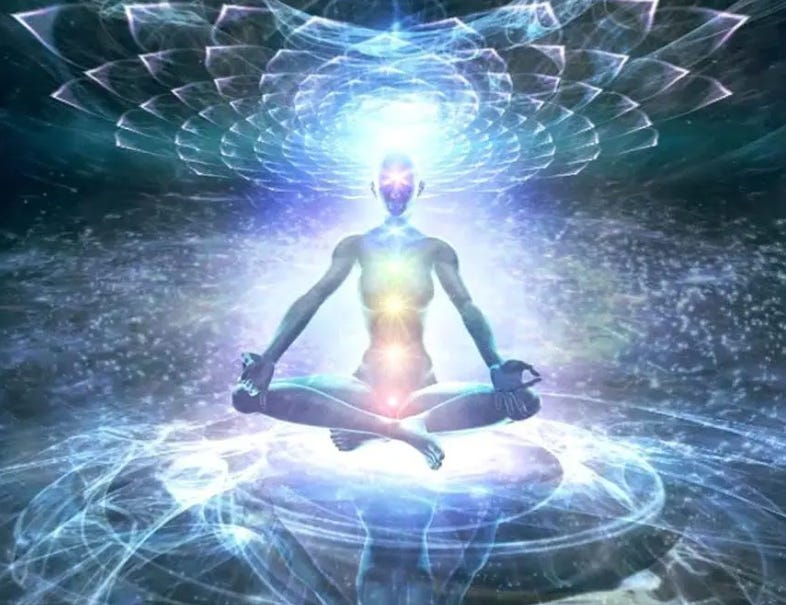
Big-Picture Thesis of Post-Mortem Void-Walking
The essay, Promethean Voidwalker by Esoteric Dixie Dharma (11/21/25), which is an analysis of the book, Thanosis, says that the most important task facing any serious spiritual practitioner today is not intellectual understanding of post-mortem survival, but the conscious, deliberate engineering of one’s own soul — an informational psychic architecture (subtle body / astral vehicle) that can survive death, resist predatory psychotronic control systems in the bardo, and retain sovereign agency across incarnations. Everything else — Gnostic myths, UFO disclosure, Nordics, lunar loosh farms — functions primarily as catalytic narrative fuel for a Promethean rebellion that must first and foremost be waged inside one’s own mind.

Most Important Points (distilled)
The soul is not a static “you” — it is a malleable informational pattern A fluid constellation of memories, dispositions, and karmic traces stored in an extracorporeal quantum substrate. It can be consciously reshaped or left to drift and be harvested.
Death is a psychotronic battlefield The untrained mind is sedated, deceived by hyper-real apparitions woven from its own residues, and recycled back into incarnation. The trained mind arrives as a pilot in a forged subtle-body craft, refuses false light traps, and navigates deliberately.
Shunyata + Promethean will = the master key Realization of emptiness (no inherent existence) prevents reification of any form (including the soul-vehicle itself), while Promethean vitalism supplies the fire to actively forge and steer that vehicle. One without the other leads either to passive dissolution or ego-inflated tyranny.
Gnostic cosmology and Jorjani’s Nordic-Archon narrative are pragmatic operating manuals, not final ontologies Their value is catalytic: they give the psyche something fierce to push against, preventing spiritual complacency and stoking the will required for psychic engineering. (In yoga, “iccha shakti” is the power of will, intention that serves as the driving force for action and creation.)
Truth as Veritas (fixed representation) is the core Archontic trap Mistaking the interface (Hoffman) or the copy (Demiurge) for ultimate reality keeps consciousness imprisoned. Truth as Aletheia (unconcealment, emergent disclosure) is the path of continuous liberation.
Struggle itself is the forge Conscious labor and intentional suffering (Gurdjieff) or “metapolemos” (cosmic strife) are ontologically necessary; comfort is the real enemy of soul-crystallization. Opposition (real or mythic) is required to generate the pressure that makes diamonds.
The endgame archetype: the Promethean Voidwalker A future human who has stabilized non-dual awareness (rigpa / Gnosis / samadhi) while simultaneously forging an indestructible astral vehicle (vajra body / kesdjan body) through disciplined resistance. This figure does not dissolve into oneness nor get processed by the lunar-samsaric machine — he authors his own continuity across worlds.
One-Sentence Summary
In an occult cosmos rigged for psychic harvesting, the only meaningful spiritual practice is the ruthless, self-directed engineering of an escape-proof soul-craft, fueled by the synthesis of ultimate emptiness (Shunyata) and unrelenting Promethean will — everything else is either fuel or distraction.
Yogic Commentary on the Voidwalker Thesis
The Promethean Voidwalker is, without knowing it, describing the exact siddha of the classical yoga-darśana and the supreme fruit of the Bhagavad Gītā.
Patañjali’s very definition of yoga is “yogaḥ citta-vṛtti-nirodhaḥ” — the complete cessation of the fluctuations that constitute the apparent ego-self. This is nothing other than the direct realization of śūnyatā under a Sanskrit name: the emptiness of the citta of any inherent, self-existent identity. When the vṛttis are stilled, what remains is the drasṭṛ, the Seer, established in its own nature (svarūpe avasthānam, I.3). This is rigpa. This is the Divine Spark. This is the Atman that was never born and never dies.
At the same time, the Gītā (especially chapters 2–6) refuses to let this realization collapse into quietist dissolution. Kṛṣṇa repeatedly commands Arjuna: fight. Act with skill, without attachment to fruits, offering every action into the fire of knowledge (jñānāgni). The sthita-prajña, the man of steady wisdom, is not a passive witness; he is a karmayogī whose every movement is yajña. The fire of tapas and the sword of jñāna are held in the same hand. This is the authentic marriage of śūnyatā and Promethean will.
The “subtle body” that must be forged for transmigration after death is called the liṅga-śarīra or sūkṣma-śarīra in Vedānta and the ativāhika-deha (“vehicle that carries over”) in the Upaniṣads. When the gross body drops, this alone migrates. The Brhadāraṇyaka Upaniṣad (4.4.2–4) and the Kaṭha (2.3.15–16) are explicit: an untrained liṅga-śarīra, still thick with vāsanās and saṁskāras, is dragged helplessly by its own karmic momentum back into the womb.
But the jīvanmukta, the one who has burned the seeds of karma in the fire of knowledge, pilots the ativāhika-deha at will — krama-mukti (gradual liberation) or sadyo-mukti (immediate liberation) according to readiness. This is exactly the “pilot arriving in a stabilized carrier.”
The bardo apparitions are the Upaniṣadic “devayāna” and “pitṛyāna” paths described in vivid, terrifying detail in the Kaṭha and Brhadāraṇyaka: terrifying forms, seductive mothers, false lights, honey-tongued guides. The untrained soul is lured by the “ancestors” or terrified by the “gods” and reborn. The knower laughs at both, recognizes them as projections of his own mind-stuff, and either merges into Brahman or deliberately takes a new body for the welfare of the worlds (Gītā 4.8). This is the vidvat-saṁnyāsa of the jīvanmukta who becomes a bodhisattva without ever adopting the Buddhist label.
Even the “loosh farm” and lunar harvesting have direct Vedic correlates: the Chandogya Upaniṣad (5.10) describes how those who perform only ritual without knowledge are reborn through smoke, night, the waning moon, and the world of the fathers — a mechanical recycling whose final station is explicitly the moon (candraloka), from which they return as rain, plants, food, semen, and new birth. The jñānī, by contrast, goes by the path of flame, day, the waxing moon, and the sun to Brahman, “from whence there is no return.” The moon is quite literally the cosmic processing station for the untrained soul.
The Promethean insistence on strife and “conscious labor and intentional suffering” is nothing but tapas (fiery spiritual, yogic discipline) — the burning effort that purifies the antaḥkaraṇa (ego) and crystallizes the golden sheath (hiraṇmaya-kośa) into a vajra (diamond) body. The Gītā’s entire sixth chapter is a manual for exactly this forging: moderation in food and sleep, āsana, prāṇāyāma, pratyāhāra, dhāraṇā, dhyāna, samādhi — all performed with the fiery resolve of Arjuna on the battlefield.
Conclusion: The Siddha and the Voidwalker Are the Same Man
The Promethean Voidwalker who stabilizes rigpa (awareness) while hammering out an indestructible astral craft through conscious struggle is not a new archetype. He is the uttama-adhikārī of Vedānta, the yogārūḍha of the Gītā, the siddha of Gorakhnāth and Matsyendranāth, the jīvanmukta who has realized Brahman yet returns by will alone to turn the wheel of dharma one more time.
The only difference is vocabulary and mood lighting. Where the Promethean speaks of rebellion against Nordic loosh farmers, the siddha speaks of offering the entire cosmos into the fire of ātma-jñāna. Both are correct. Both are describing the same indestructible diamond vehicle that crosses the flood (Gītā 2.70, Dhammapada 85–89) while the untrained are swept away.
The Vedic tradition already solved the problem the Promethean is heroically discovering: realize the Self that was never bound (śūnyatā of the ego), and then — from the unshakable certainty of that realization — perform every action as yajña (offering/sacrifice). The fire is stolen and returned in the same gesture. Prometheus and Agni are reconciled in the heart of the knower who has become the offering, the offerer, and the flame.
That is the final secret of both paths. Tat tvam asi (Thou are That; The individual self (Atman) is one with the ultimate reality or Supreme Soul (Brahman). This realization is considered a path to liberation or Moksha.) And the war is over the instant you know it.
Om Shanti. Peace.