The Yogaville Farm
Karma Yoga, Community, and the Sacred Intelligence of the Living Earth

A Place Where Practice Becomes Tangible
At the Yogaville farm, the usual distinction between spiritual practice and ordinary work begins to dissolve. One does not arrive merely at a site of production, nor simply at a scenic agricultural landscape attached to an ashram. One enters a field of integration, a place where philosophy becomes tactile, where seva takes visible form, and where the ideals of yoga are tested not in abstraction but in weather, soil, moisture, tools, and shared labor. The farm is not separate from the meditation hall, the temple, or the classroom. It is another chamber of the same sacred organism, another place where consciousness is trained through disciplined participation in reality.

This becomes clear almost immediately. The farm reveals how much care living systems require. Seeds must be warmed. Moisture must be regulated. Soil must be replenished. Beds must be weeded. Air must circulate. Crops must be timed, protected, harvested, and carried. Nothing thrives by sentiment alone. In this sense, the farm offers a profound corrective to both modern alienation and vague spirituality. It reminds us that growth—whether agricultural, communal, or spiritual—depends upon the creation of conditions. Grace may be mysterious, but cultivation is exacting.
The Greenhouse and the Discipline of Beginnings
Among the most striking features of the farm is the ingenuity with which life is coaxed into emergence. Repurposed refrigerators become germination chambers. Temperature probes regulate warmth. A crock pot in the base of the chamber provides both heat and humidity, maintaining the precise conditions that seeds require in order to break open and begin. What might appear to an outsider as improvised rural practicality reveals a deeper intelligence: life responds when the environment is rightly prepared.
There is an unmistakable spiritual resonance here. A seed does not germinate because one wills it emotionally. (Although, this is possible in higher-level yogic abilities (siddhis)). It germinates when the proper conditions converge. The same is true of the inner life. Aspiration alone is not enough. The soul, too, requires atmosphere. It requires steady teaching, a protected container, repeated practice, and enough warmth to encourage emergence without forcing it. In that sense, the greenhouse is more than a greenhouse. It is a metaphor for the ashram itself, and perhaps for every serious sādhana. We do not manufacture awakening. We prepare for it, protect its beginnings, and cooperate with its unfolding.
Trays of kale, collards, shallots, tomatoes, peppers, and other young plants deepen this lesson. Each seedling represents time, timing, and attention. Nothing in the greenhouse is hurried. The whole structure teaches one of yoga’s central truths: life unfolds according to rhythm, not command.
The Farm as a School of Perception
A day at the farm sharpens perception. What initially looks like a simple bed of green quickly differentiates itself into collards, kale, mustard, spinach, arugula, green onions, chickweed, and volunteer growth. One learns to see distinctions that previously went unnoticed. This is not only an agricultural skill. It is a spiritual one. Yoga, after all, depends upon discrimination: the ability to distinguish the nourishing from the depleting, the essential from the accidental, the real from the merely habitual.
Weeding makes this principle visible. To kneel in the soil and clear space around a useful plant is to practice viveka in literal form. The weeds are not evil. They are simply out of place. They draw resources away from what has been intentionally planted. The parallel to inner life is almost too obvious to miss, yet the farm allows it to be discovered naturally rather than preached. Thoughts, habits, reactions, attachments, and distractions behave much like weeds. Some are shallow and easy to remove. Others are deeply rooted and resist extraction. In both cases, transformation requires attention, patience, and a certain gentleness. Pull too aggressively, and one disturbs what one is trying to protect.
This is one reason farming belongs so naturally within a yogic environment. It trains observation without narcissism. It turns awareness outward and inward at once.
The Sacred Margin: Herbs, Memory, and Healing
One of the most evocative dimensions of the farm is its medicinal perimeter, where herbs and healing plants line the edges of the cultivated space. Mint, parsley, goji, stevia, and other medicinal or culinary plants dwell along the margins, tended through memory and practical intimacy rather than through theory alone. The perimeter feels like a living archive, a place where knowledge persists not mainly in books but in relationship.
That detail matters. Modern life often privileges centralized, systematized knowledge while neglecting forms of wisdom that survive through familiarity, repetition, and care. The herb border carries a deeper epistemology. It suggests that some of the most valuable forms of knowing are held by elders who have lived close enough to the earth to remember what grows where, what heals what, what returns in season, and what only appears dead before spring reveals otherwise. A stevia plant in dormancy may look lifeless. Yet hidden in that apparent barrenness is sweetness waiting for warmth.
The image is spiritually suggestive. Much in human life appears dormant before it becomes fruitful. Many states mistaken for endings are actually intervals of latency. At the farm, one is reminded that life often conceals itself before revealing itself again.
Hoop Houses, Improvisation, and the Architecture of Growth
The hoop houses at the farm embody another essential lesson: form matters, but perfection is not a prerequisite for usefulness. One structure was built through improvisation, hand-bent and imperfect, yet still productive. Later structures reflect growing knowledge and refinement and wisdom from the Amish. Together they reveal a principle at once agricultural and spiritual: sincere action precedes mastery, and mastery usually grows by iterating upon what was once merely earnest.
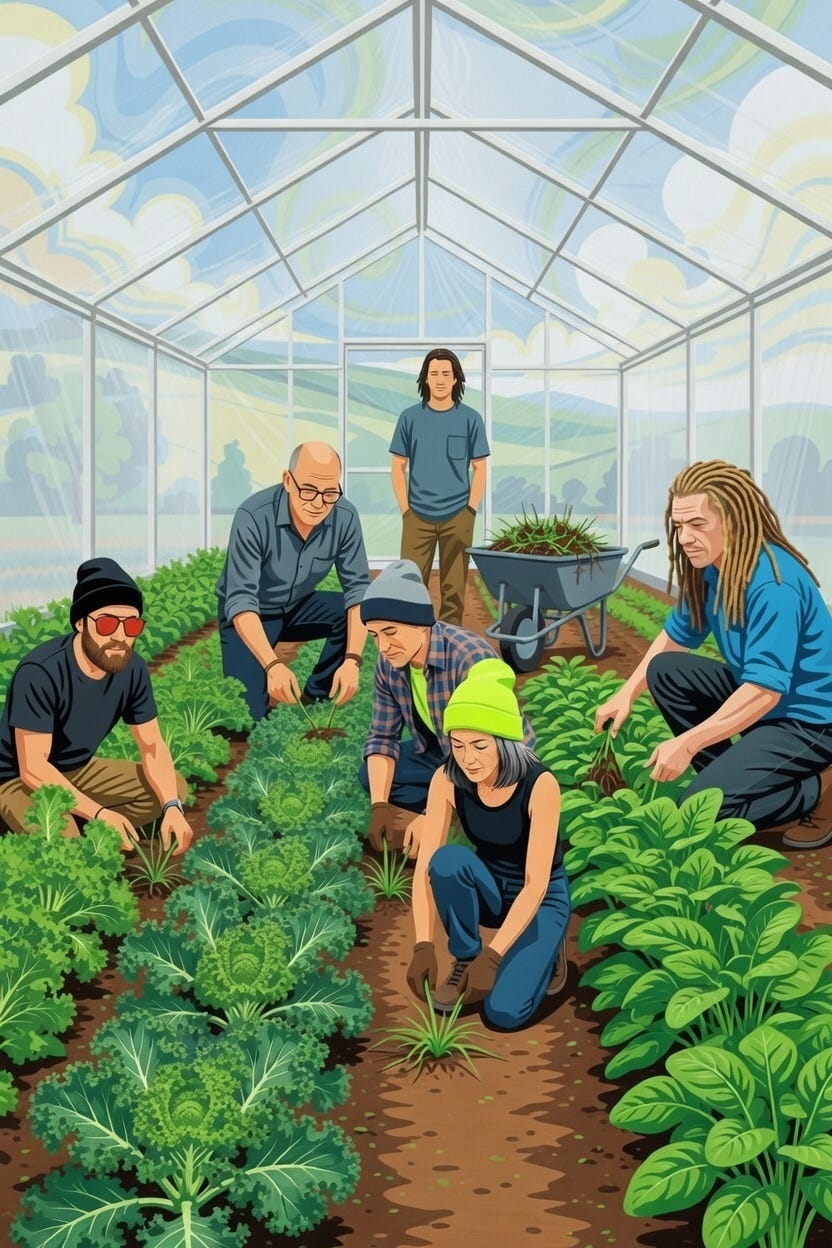
Inside these houses, the logic of cultivation becomes more concentrated. Spinach flourishes with astonishing vigor. Kale grows in rows, as expressions of attentiveness to community needs. Even this small detail carries weight. When food is grown for real people, and with awareness of who will receive it, agriculture becomes relational rather than abstract. Service ceases to be generic. It becomes responsive.
This is where karma yoga becomes concrete. Work is no longer a vague offering to the universe. It becomes a specific act of nourishment directed toward an actual community. One weeds not only for service but so the spinach can grow. One harvests not for symbolic merit but so others may eat. The physicality of this relationship protects karma yoga from becoming sentimental. It keeps service honest.
Weather, Impermanence, and the Education of the Elements
The weather at the farm intensifies the teaching. Rain passes through. Snow falls, then clears. Yesterday’s hot evening gives way to wintry cold. The day move through multiple seasons as though nature were compressing a whole philosophy into a few hours. Like how the Yoga Sutras compress vast teachings in a few aphorisms. This instability is not an inconvenience alone. It is pedagogy.
To work in such conditions is to relearn humility. The body remembers that it is not sovereign over circumstances. Plans must adjust. Expectations soften. One’s relationship to time changes. Modern culture often surrounds itself with insulation, climate control, convenience, and abstraction, but the farm reintroduces elemental life. Mud matters. Wind matters. Wet socks matter. Exposure matters. Suddenly spirituality is no longer an affair of concepts alone. It becomes a question of how consciousness meets conditions that it did not choose.
This is one of the farm’s deepest gifts. It restores an intimate relationship with impermanence. Not as doctrine, but as fact. One cannot remain at the level of theory when the sky itself keeps changing. The practitioner learns to adapt steadily. That steadiness may be closer to real equanimity than many loftier claims.
Community Formed by Shared Action
The social field of the farm is equally instructive. Conversation arises naturally while people weed, harvest, carry, examine, compare, laugh, and warm themselves over tea. The result is a kind of community that feels less performative than the community produced by many intentional settings. People speak not because they are asked to share, but because labor gives speech a human scale. Work creates enough common purpose to make relationship simpler.
This is spiritually significant. In many environments, people attempt intimacy through disclosure before they have developed trust through participation. The farm reverses that sequence. It allows people to do something together first. Through shared labor, humor becomes easier, philosophy becomes less self-conscious, and personal histories emerge with more ease. Technical farming conversations blend seamlessly into discussions about lineage, yoga, India, ritual, law, weather, music, family, and the tests of spiritual life. The work itself holds the space.
This reveals something important about sangha. Community is not merely a circle of shared beliefs. It is a field of coordinated action. A sangha deepens when people practice, serve, and endure together. The farm offers precisely that kind of environment.
The Vertical Growth of the Tomato
Among the most suggestive images from the farm is the trellised tomato. Rather than sprawling, the plant is trained upward along string, clipped and guided as it grows, and eventually drawn laterally across the structure. The method requires consistency and foresight, but it yields greater health, productivity, and accessibility. The plant is not prevented from growing. It is taught how to grow well.
This image serves as one of the finest metaphors for yogic life. Human energy also sprawls when left wholly untrained. The mind disperses. Desire branches in every direction. Attention pools low to the ground. Discipline does not destroy vitality; it gives vitality architecture. It elevates growth toward light. A trellis is not a prison. It is a support.
So too with sādhana. Practice does not exist to suppress life but to orient it. Teachers, teachings, forms, vows, habits, and sacred routines function as trellises for consciousness. They help energy rise, mature, and bear fruit. Without structure, potential remains diffuse. With it, ordinary life can become astonishingly generative.
Bees, Interdependence, and Hidden Labor
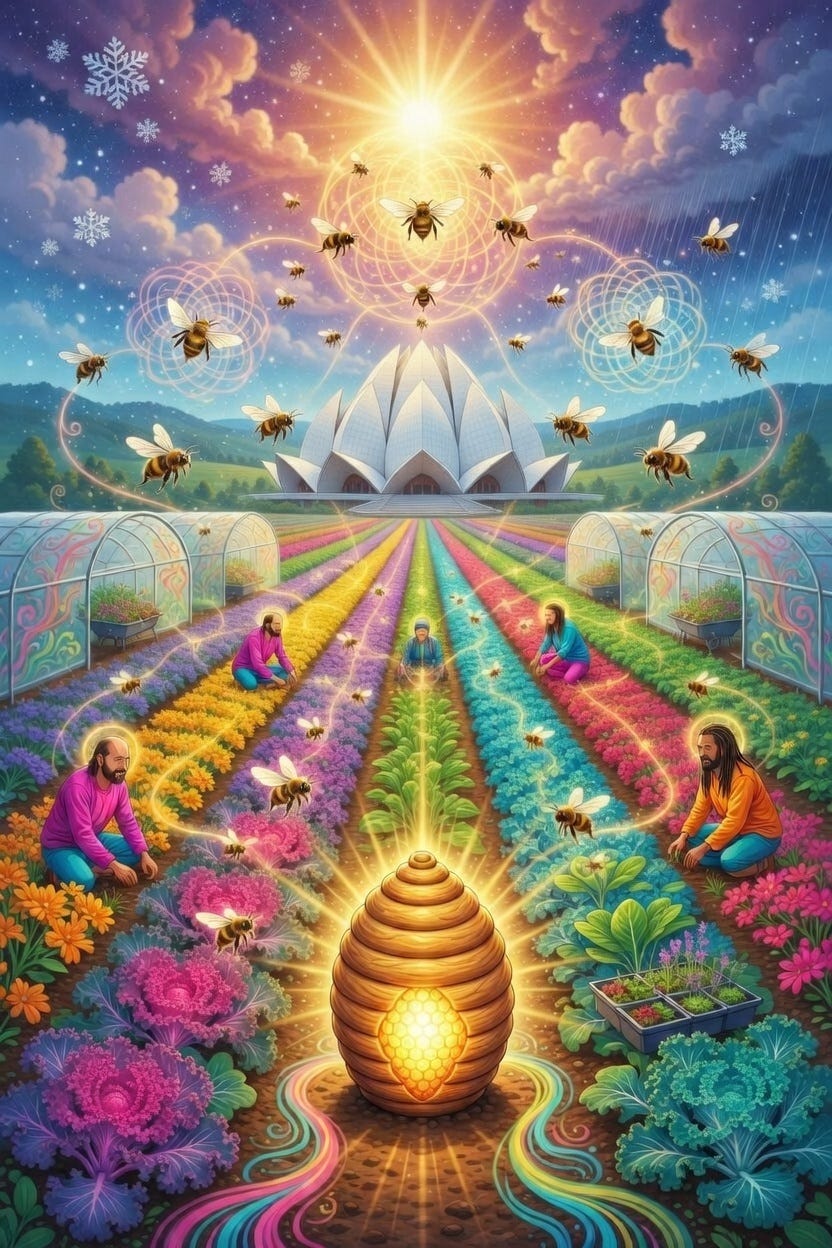
At the farm’s edge, the bees introduce another dimension of the teaching. On cold days they do not fly. They gather inward, vibrating together to generate warmth and preserve the life of the hive. In a single image, the bees reveal both interdependence and disciplined collective intelligence. They do not dramatize survival. They enact it.
The farm depends upon such beings while never fully controlling them. Pollination, fruiting, and continuity rely upon forces outside human command. This dependence is morally and spiritually clarifying. It reminds us that even the best-managed systems are upheld by invisible cooperation. We do not feed a community alone. We work within networks of life that precede us and exceed us.
There is humility in this recognition, and also gratitude. The earth is not a passive backdrop to human projects. It is an active field of intelligence, relationship, and reciprocity.
From Labor to Offering
By the end of the day, the farm reveals its most complete teaching: that labor becomes sacred by being consciously offered. The vegetables harvested will soon be eaten. The beds cleared will continue producing. The community will be nourished by leaves, stems, roots and honey. What began as work returns as sustenance. What was given through effort returns as life.
This closure of the circle is deeply satisfying because it restores meaning to action. So much modern labor is alienated, its results distant or opaque. At the Yogaville farm, cause and effect remain visible. One can feel the relationship between one’s hands and another’s nourishment. That visibility heals something in the human psyche. It reminds us that work, when rightly situated, can be an expression of love.
This is the essence of karma yoga. Not merely action without attachment in an abstract philosophical sense, but action purified through service, relationship, and offering. One need not escape the world to encounter the sacred. One must learn to serve within it without fragmentation.
Conclusion: The Farm and the Soul
The Yogaville farm stands as a model of what integrated spiritual life can look like. It unites contemplation and practicality, devotion and technique, beauty and maintenance, community and responsibility. It asks for humility, discipline, reverence. It is at once earthy and luminous.
To be there is to receive an education in right relationship. One learns how growth depends upon conditions, how service becomes real through repetition, how community is strengthened through shared effort, how weather trains equanimity, how structure supports life, and how the earth responds to steady care. One also learns that the inner and outer lives are not separate domains. The same laws govern both. Seeds need warmth. Souls need warmth. Beds must be cleared. Minds must be cleared. Crops require support. Aspirants require support. Harvest arrives only after long and mostly invisible preparation.
In that sense, the Yogaville farm is not merely a farm. It is a spiritual text written in soil, weather, herbs, insects, greenhouses, and human hands. It teaches without argument. It reveals without proclamation. And row by row, season by season, it reminds those who enter it that yoga is not only something one practices. It is something one grows.
om shanti