Fear & The Vertical Path
What Modern Traditional Climbing Teaches Us About Fear—And What Yoga Knew All Along

There is a moment in traditional rock climbing when the distance to your last piece of protection grows large enough—and the terrain below unforgiving enough—that you enter what many trad climbers call a ‘no-fall zone,’ where falling could have catastrophic results. The physics become unforgiving: fall here, and you die. There is no rope trick, no partner’s catch, no second chance. You are alone with gravity, friction, and the contents of your own mind.
This is not recklessness. It is, paradoxically, one of the most precise laboratories for understanding fear that human beings have ever devised.
For over two decades, I climbed at this edge, starting with Vertigo on Cannon Cliff (NH) in 1999, building up to ascents on Wallface (NY), Tetons’ grand traverse (WY), Wind River cirque traverse (WY), Half Dome, Yosemite (CA), Black Canyon of the Gunnison (CO), and so on.
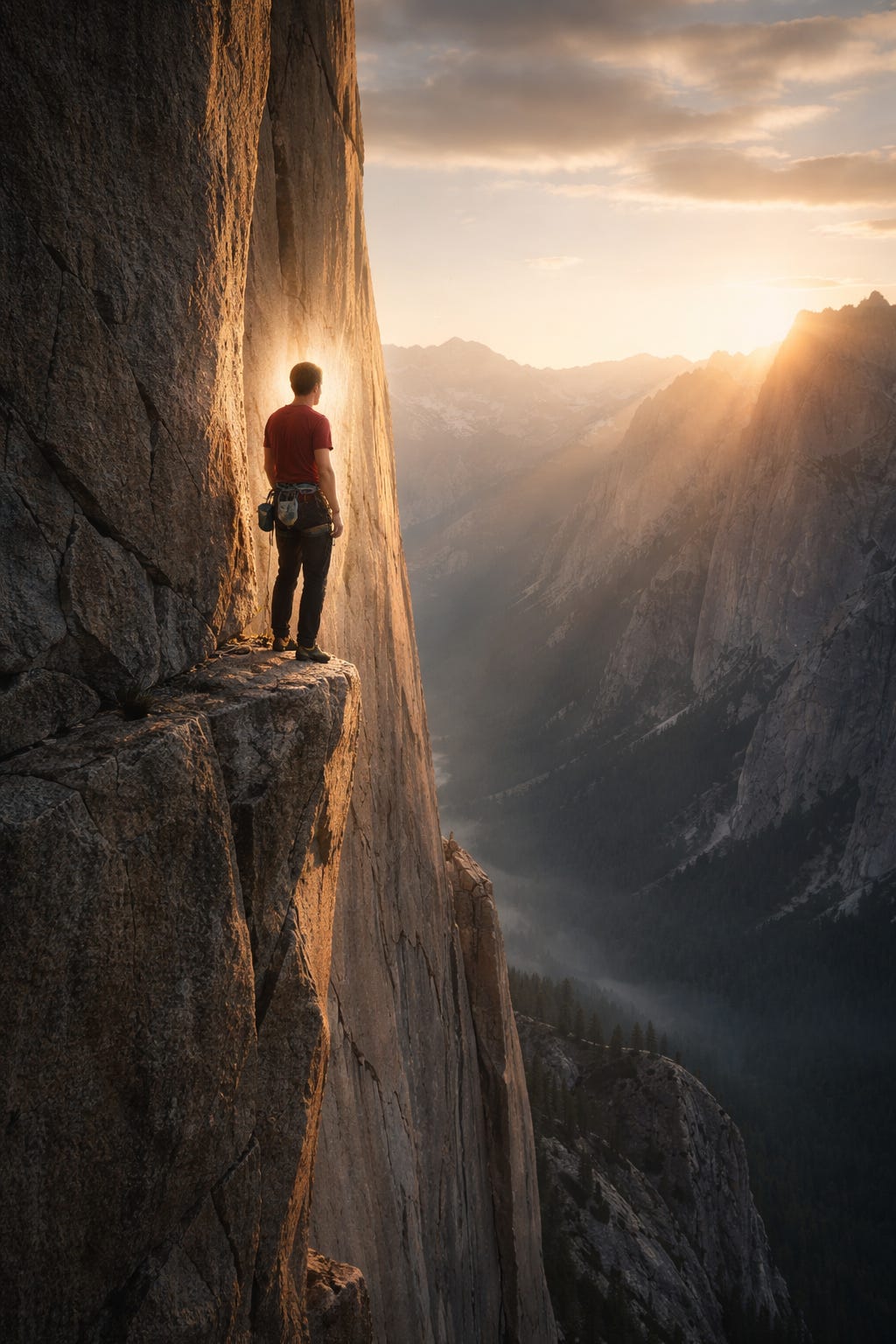
The Fall That Dissolved My Fear of Death
I was only seventeen when I tasted this edge in an unexpected way. On a hard sport route on Waimea Wall (5.13a/b) at Rumney, New Hampshire, I skipped a bolt at the upper crux, maxed out, and pulled up rope to clip the next bolt. Completely fatigued, my other hand slipped off the rock. As I fell, I simultaneously made the clip—but the rope was behind my foot and flipped me upside down. The extra rope in the system and dynamic stretch turned it into roughly a thirty-foot fall, stopping me just a few feet from the ground. While falling, my spirit ejected from my body, preparing for physiological death. I lost consciousness briefly and found myself surrounded by brilliant white light, suspended in an eternal state of bliss, love, and omniscient consciousness. “I” realized that reality is not what we think it is, and experienced the truth that death is an illusion. That single experience completely dissolved my fear of death. I wish I could offer this liberating glimpse to others. It was also accompanied by a dramatically expanded appreciation for life—and for climbing itself as a portal to transcendence, samādhi, and mokṣa.
Afterwards, on numerous occasions, I have found myself standing on crystalline edges an inch wide, a few hundred or a thousand feet of air beneath my feet, and learning something that the yogis of India articulated millennia ago: that fear is not primarily about situations, but about the nature of consciousness itself. And that the path through fear—whether on a Himalayan wall or in the quiet negotiations of daily life—follows remarkably consistent principles.
A swami at Yogaville recently asked me: Can you translate what you learned about overcoming fear on rock to social interaction? Can it help us come out of our comfort zones?
The answer is yes. But to understand how, we must first go to the sharp end of the rope.
The Anatomy of Fear at Altitude
Traditional climbing—as distinct from sport climbing, bouldering, or gym climbing—involves placing your own protection as you ascend. You carry a rack of metal devices, slot or cam them into cracks, clip your rope through them, and hope they hold if you fall. But rock doesn’t always offer placements where you need them. Sometimes the crack closes, or the angle steepens, or the holds shrink to nothing just when you’re furthest from safety.
In these moments, climbers confront what Arno Ilgner, in The Rock Warrior’s Way, refers to as dis-ease of the ego—the fundamental discomfort of a self that perceives itself as separate and therefore vulnerable. The body’s alarm system activates. Breathing constricts. Vision narrows. Muscles that need to remain supple for delicate footwork begin to clench.
What’s striking is how poorly this fear response correlates with actual danger. Researchers in climbing psychology have documented that climbers often feel more afraid on well-protected routes than on objectively dangerous ones. The fear is not reading the situation; it is reading the mind’s interpretation of the situation—a crucial distinction.
Don McGrath and Jeff Elison, in Vertical Mind, describe this as a cognitive “threat appraisal” system operating largely below conscious awareness. The system evolved for a different world—one of predators and tribal conflicts—and now fires in contexts it wasn’t designed for. Your prefrontal cortex knows the difference between a mountain lion and an intimidating sequence of rock moves. Your amygdala does not care.
This is the first lesson climbing offers: fear is ancient software running on modern hardware, and it does not update automatically.
What Climbers Have Learned
The literature of climbing psychology represents decades of accumulated wisdom about operating in high-consequence environments. Certain principles recur across texts from Bone Games to Fear!: Extreme Athletes to Maximum Climbing:
1. Arousal is not fear; interpretation is.
The physiological sensations of fear—racing heart, shallow breath, trembling limbs—are identical to the sensations of excitement and peak performance. Elite climbers learn to reframe these signals not as warnings of danger, but as evidence of readiness. The body is mobilizing resources. The question is whether consciousness will direct those resources toward performance or toward panic.
2. Fear increases with attachment to outcome.
Climbers who fixate on reaching the summit, or on not falling, or on looking competent, experience more disruptive fear than those who remain absorbed in the immediate movement. Ilgner calls this “process orientation”—staying with the texture of rock under fingertips, the placement of the next foot, the rhythm of breath. The moment consciousness leaves the present and projects into imagined futures (falling, failing, dying), the fear response amplifies.
3. Comfort zones expand only through voluntary discomfort.
No climber ever became capable of leading difficult routes by staying on easy ones. The nervous system adapts to challenges it is actually exposed to, not challenges it contemplates. But the exposure must be graduated, intentional, and processed afterward. Jeff Lowe, one of the great alpinists, spoke of “calibrated risk”—choosing challenges just beyond current capacity, rather than leaping to dangers that would overwhelm the system’s ability to learn.
4. The deepest fears are not about falling.
Ask climbers what they fear, and the sophisticated ones don’t say “falling.” They say: Discovering I’m not who I thought I was. Being seen to fail. Losing control. Not being enough. The rock becomes a mirror. What looks like fear of death is often fear of ego-dissolution—fear of the self’s fragility being exposed.
This is where Ernest Becker’s The Denial of Death becomes relevant. Becker, who won the Pulitzer Prize in 1974, argued that all human behavior is ultimately motivated by terror of mortality. We construct elaborate systems of meaning and identity to shield ourselves from awareness of our transience. The climber on the sharp end of the rope, with nothing between consciousness and consequence, has momentarily run out of psychological hiding places. The denial mechanisms fail.
And sometimes, in that failure, something else becomes possible.
The Yogic Cartography of Fear
Classical yoga offers a precise map of what the climber encounters on the rock face. In the Yoga Sūtras, Patañjali identifies five kleśas—afflictions or obstacles that bind consciousness to suffering. They are:
Avidyā (ignorance, misperception of reality)
Asmitā (ego-identification, confusing the self with its roles and attributes)
Rāga (attachment, grasping at pleasure)
Dveṣa (aversion, pushing away pain)
Abhiniveśa (clinging to life, fear of death)
Patañjali presents avidyā as the root from which the others grow. We misperceive reality—specifically, we perceive ourselves as separate, isolated entities in a threatening world—and from this fundamental error, the other afflictions cascade. We construct an ego to defend this imagined separate self. We grasp at what seems to support it and flee from what threatens it. And beneath all other fears, we cling to biological existence itself, terrified of the annihilation of the very self that never existed as we imagined it.
This maps precisely to what climbers discover in no-fall zones. The fear is not really about the fall. The fall is merely the occasion for the deeper fear—the existential insecurity of a self that senses its own groundlessness. Climbers sometimes report that the moments of greatest terror come not when the body is most at risk, but when the mind has nowhere left to hide. The holds become too small for denial.
Yet Patañjali also describes a path through the kleśas. The practices of yoga—the eight limbs of aṣṭāṅga—are designed not to eliminate fear by force, but to dissolve the avidyā from which fear grows. When the root is addressed, the fruit withers naturally.
Samādhi—the integrative absorption that is both the goal and ground of yoga—is sometimes described as the experience of unified awareness in which the illusion of separation temporarily dissolves. In that dissolution, there is no separate self to defend, and therefore no basis for fear.
Remarkably, accomplished climbers describe almost identical states. In the midst of consequential climbing, there can arise a condition of absolute presence—no fear, no sense of a separate self climbing, just fluid movement arising spontaneously. The climber John Gill called it ‘kinesthetic enlightenment.’ The consciousness that fears is not present; only the climbing remains.
The Convergence
What becomes clear when we hold these two bodies of knowledge together—traditional climbing psychology and Raja Yoga philosophy—is that they have independently mapped the same territory.
Both recognize that:
Fear is not primarily about external circumstances. It is about the relationship between consciousness and circumstance—specifically, the way an imagined separate self interprets events as threats to its existence. Change the relationship, and the fear transforms.
The deepest layer of fear is existential. Surface fears—of falling, of social rejection, of failure—are branches from a root that reaches toward mortality and, deeper still, toward the suspicion that the self is not what it appears to be.
Exposure is necessary but not sufficient. Simply having frightening experiences does not automatically produce growth. The exposure must be processed, integrated, metabolized by a consciousness that remains present to what is happening. Otherwise, trauma accumulates rather than dissolves.
Identity is the leverage point. The climber who sees themselves as “someone who doesn’t fall” will be paralyzed by fear of falling. The climber who holds identity lightly—who is not invested in any particular outcome—moves freely. Yoga makes this even more explicit: asmitā, the grip of ego-identification, is what makes abhiniveśa, the fear of death, so powerful. Loosen the grip of identity, and fear loosens with it.
There is something beyond fear. Both traditions point to a condition of consciousness in which fear is not suppressed or overcome, but simply doesn’t arise because its preconditions aren’t present. The climber on a difficult route, fully absorbed in movement, experiences this temporarily. The yogi in deep meditation experiences it more systematically. In both cases, it is not will or courage that dissolves fear; it is presence—a quality of attention so complete that the self-referential loop generating fear cannot sustain itself.
The Transfer: From Rock to Life
Now we can return to the swami’s question: Can this be translated to social interaction? To the fears that limit us in daily life? The parallel is more direct than it first appears. Consider social anxiety—fear of judgment, rejection, humiliation. The dynamics are identical to what happens on rock:
The body’s arousal system activates in response to perceived threat.
The threat is not physical, but egoic—the risk is to the imagined self, not the biological organism.
The fear increases with attachment to outcome (being liked, appearing competent, avoiding awkwardness).
The response is often disproportionate to actual consequences.
The fear feeds on avoidance; the comfort zone shrinks when unchallenged.
What rock climbing offers is a clean laboratory for working with these dynamics. The consequences are real enough to demand attention. The feedback is immediate—you either move through the fear or you don’t. The lessons embed themselves in the nervous system, not just the intellect.
The swami suggested I could become a “tutor” for psychological fear-work, helping people make “first ascents” of their inner cliffs— to go up routes they didn’t think they were capable of, to teach them how to manage their fears.
The tools already exist. Yoga has catalogued them for millennia:
Prāṇāyāma: breath practices that regulate the autonomic nervous system, downshifting the fear response
Pratyāhāra: the deliberate withdrawal of attention from external stimuli and its redirection inward
Dhāraṇā and dhyāna: concentration and meditation practices that develop the capacity to remain present rather than being hijacked by catastrophic imagination
Vairāgya: non-attachment, the practice of loosening the grip on outcomes
Climbing adds something specific: the necessity of action. Meditation can become a refuge from engagement, a spiritual bypass of the very situations that would forge courage. But you cannot bypass a no-fall zone. You must move through it. Body and mind together, in real time, with real consequences.
The synthesis I envision is this: using the principles of graduated exposure from climbing psychology within a framework shaped by yoga’s understanding of fear’s root causes. Not merely habituating people to frightening situations, but helping them see into the avidyā that makes situations frightening in the first place—while simultaneously building the nervous system’s capacity to tolerate activation without collapse.
The Practice of Vertical Living
If fear is, as I’ve suggested, not primarily situational but structural—embedded in the very architecture of ego-consciousness—then working with fear is central to the spiritual path.
This is what the swami understood, I think, when she said: Our personality is very limited by our fears. We have our comfort zones.
The comfort zone is the territory where the ego feels secure. Beyond its edges, the self-structure begins to tremble. Most people, most of the time, stay inside—not because they lack courage, but because they don’t see the cage. The walls of the comfort zone become the walls of the world.
Traditional climbing made the cage visible to me. When you’re standing on a tiny ledge with no protection—but not terrified, because you know that the terror is not about the exposure or the potential fall—that you’ve been this frightened at job interviews and first dates and difficult conversations—something shifts. You see that you’ve been living inside a fear that has nothing to do with falling.
The vertical path is a metaphor with teeth. Ascent requires leaving the ground behind. Commitment grows with elevation: the higher you go, the more consequence attends each move. There are no-fall zones in every life: moments when the stakes are real and there’s no going back. And at the top, if you arrive, the view reveals that the mountain was internal all along.
Yoga, in one of its etymological meanings, comes from the root yuj—to yoke, to unite. The climber on the wall, fully present, experiences a momentary yoking of body, breath, attention, and action. The fragmentations of ordinary consciousness temporarily heal. This is a kind of yoga, whether or not it wears the name.
And it is available not only on granite, but anywhere we choose to meet our fear with presence rather than flight.
An Invitation
The swami said she suspected that her fears were common ones. This may be the most important point. The fears that limit us are not exotic. They are not evidence of special brokenness. They are the ordinary inheritance of ego-consciousness, the predictable fruit of avidyā. We are all standing on small ledges, all gripping harder than necessary, all imagining falls worse than the ones we might actually take.
What would it mean to bring the climber’s discipline—graduated exposure, breath regulation, process orientation, non-attachment to outcome—to the ordinary fears that shape our lives? To treat social anxiety, creative blocks, intimacy avoidance, and existential dread with the same precision that alpinists bring to a Himalayan ascent?
It would mean accepting that growth requires discomfort—that the comfort zone, left unchallenged, becomes a prison.
It would mean understanding that fear is information about our edge, not a verdict on our capacity.
It would mean practicing presence: the quality of attention that remains with what is actually happening rather than fleeing into imagined catastrophe.
And it would mean, ultimately, investigating the self that fears—asking whether that self is as solid, as separate, as vulnerable as it believes itself to be.
The rock does not care whether you are afraid. It offers only consequence and feedback. In this, it is like life itself: neutral, unyielding, responsive only to what you actually do.
The question is whether we will move through our fears—one handhold, one breath, one moment at a time—and discover what lies beyond.
The swami was right: there is a new kind of tutoring here, waiting to be born. Not a life-coaching technique or a productivity hack, but something older and simpler—the ancient practice of accompanying people to the edges of their known world, and witnessing what they become when they step beyond.
I’ve done this on rock. The time has come to do it in other terrains.
The vertical path awaits.

om shanti