The Threshold: Day Four
Basti, the Oil at the Brow, and the Crown of Ayurveda

Notes from the cleansing table at Riverview Spa, under the hands of Dr. Michael (Muktan) Sullivan
The wisdom of the cleanse manifested as a headache.
Three days in, the caffeine I had not properly weaned off before beginning pañcakarma had taken up residence at the base of my skull — that old weak spot, the one Muktan and I have been working over all week. By the fourth morning I struck a bargain with myself and drank half a cup of coffee. The relief was immediate, and so was the lesson, which is the way of these things. By the time I sat down with Muktan it had faded to a one out of ten, but it had made its point. When I confessed the coffee, he was obviously disappointed. He only said: a headache that lasts three days is the body telling you something is moving through the system.
That is the whole pedagogy of pañcakarma in a sentence. The body, emptied and softened, begins to tell the truth. The headache was not the enemy. The headache was apāna — the downward, eliminative current of vāta — pointing at exactly what wanted to leave. And here I was, negotiating with it over half a cup.
So before I write a word about the bliss, let me be honest about the doorway. The doorway is the more interesting part of the story.
What People Come Here For
A word, first, about why anyone submits to a week like this, because I arrived with my own reasons.
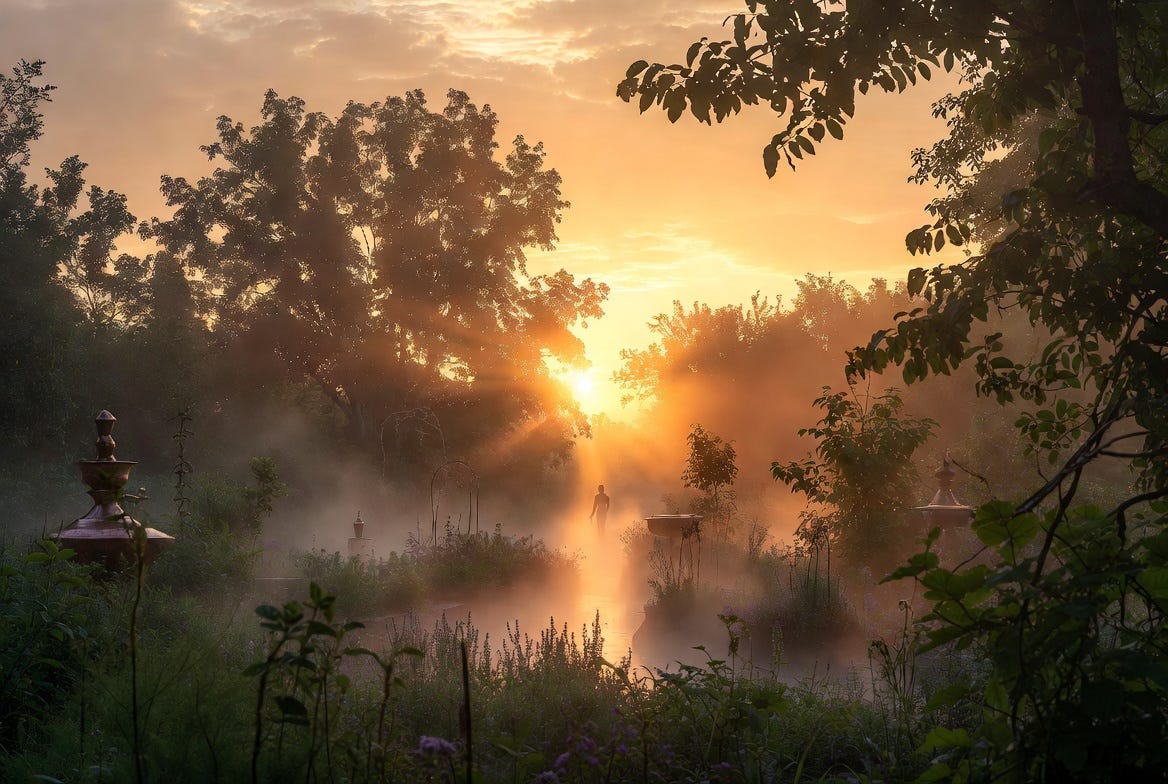
Most people do not come for enlightenment. They come for something concrete: the digestion that’s been wrong for years after the specialists ran out of ideas; the sleep that won’t hold; the joints that ache, the skin that won’t settle, the anxiety that hums under everything like a refrigerator that never shuts off. They come depleted from a hard season — overwork, travel, grief, too many medications — wanting, in plain terms, a reset: to clear the accumulated residue the tradition calls āma and feel like themselves again. Some, like myself, come for prevention, the oldest Ayurvedic motive of all — not waiting for the disease but periodically clearing the channels so the system stays resilient into old age. Rasāyana, the texts call it: rejuvenation.
What surprises nearly everyone is how much more arrives than they bargained for. You come to fix a gut and end up meeting your own mind. The relief you wanted shows up — and then something you didn’t know to ask for shows up behind it. That is the real signature of good pañcakarma: it answers the question you brought and poses a better one.
After my own treatment-meal on the third day I understood the appeal in my body before I could explain it. “You’ll feel like a million bucks,” Muktan had promised, and I did — a clean well-being I one does not get from any supplement or drug. (Except for the headache. The body always keeps one thing honest.)
The Shape of the Day
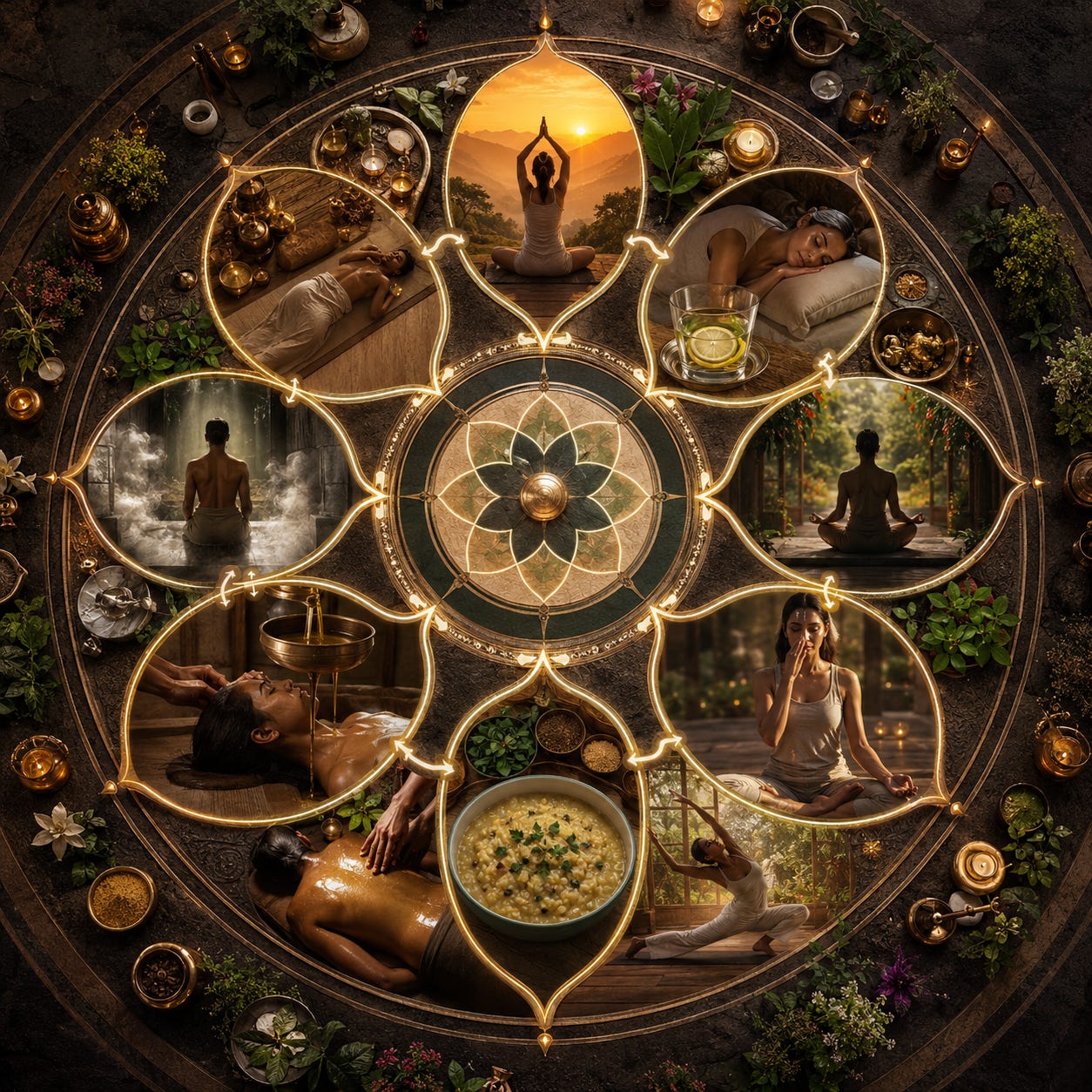
The fourth day held a particular arc. The structure is half the medicine. Nothing here was random. Each step prepared the tissue for the next — the way you cannot ask a ligament to open before you have warmed it, the way you cannot break a fast with pizza. This is the part of Ayurveda the spa-day version of the word never conveys: it is not pampering, it is sequence — a clinician’s sequence, refined over millennia and refined again by the particular clinician standing over you, who watches how your system answers and then personalizes and adjusts the next step accordingly.
It began at sunrise with salutations, and then, at eight, with fresh lemon juice: the first thing in, warm and sour, waking the digestive fire before anything was asked of it. At nine came the abhyaṅga, the warm-oil massage — the whole body anointed and worked until the tissue softened and gave up what it had been holding. Then fifteen minutes in the steam room, the heat opening what the oil would later carry out. Then half an hour of shirodhara: warm oil poured in a slow, unbroken thread across the forehead. And then, in the afternoon, basti. The enema. The first of my life.
Afterward, lunch — kicharī with greens from the garden and my own homemade ghee, the butter sourced from a small Amish farmers’ market fifteen miles down the road. Simple food for a softened body, the way you ease back into eating after a fast rather than assaulting the open tissue. This is true luxury: real food, grown nearby, prepared for the state your body is actually in that day. The late afternoon, near five, closed with an hour of āsana — my own practice now, which Muktan has begun letting me run myself, watching from the side and occasionally giving me alignment cues. Then prāṇāyāma, then guided meditation, then rest.
Sunrise salutations, juice, oil, steam, oil again, basti, food, āsana, breath, meditation, rest. Preparation, mobilization, surrender, release. If you have eyes for it, that is the whole architecture of a kuṇḍalinī ascent compressed into a single day — and I will come back to that, because it is the thing I most want to say.
The Strangeness of Re-Entry
Anyone considering this should know: a cleanse pulls you out of ordinary time.
The evening before, fresh from the day’s treatments, I went to fulfill a supper-cleanup shift at the Yogaville ashram and found myself in the ashram kitchen among extraordindary people, feeling as though I’d walked in from a slightly different dimension. I was about to drive home before I remembered it was Wednesday. Everyone else moved at the speed of the ashram; I moved at a slightly lower speed of the cleanse, half-submerged in an equinimity and tranquility that the Ashram holds space for. The deeper you go, the more the ordinary world acquires a faint, dreamlike outline. For a week you are not quite of this world, and this is itself part of what heals — a forced break from the self that rushes and grips and makes the āma in the first place.
On the Basti, and Doing a Thing for the First Time
Let me dispense with the squeamishness directly, since the reader is probably carrying some on my behalf.
Basti is, in the classical texts, the crown of the pañcakarma therapies — the root charaka and the rest rank highest, because the colon is the principal seat of vāta, the wind that governs every other current in the body. Cleanse the seat of vāta and you are not unclogging a pipe; you are re-tuning the instrument that conducts everything else.
Knowing that intellectually did nothing to make the first one less of a threshold — and it was, in the most literal sense, a first: the first time anything had gone in rather than out. Muktan walked me through it, which is its own kind of mastery. Get down on your hands and knees. Slowly insert the oiled tube. Release the valve. The first half of medicinal oil will go in, and then your body will want to push it back; close it off, wait, and put the rest in, which is mostly pure oil. Then elevate the pelvis and hold — one minute, five, fifteen, whatever you’re comfortable with. And if you make a mess, it’s fine. Let the gravity do the work, he said. That last instruction is the whole of Ayurveda, really: don’t force, cooperate with what already wants to happen.
The body’s first instinct is to reject — he had warned me. Things aren’t supposed to go that way, the muscle insists, and so you hold what it wants to expel, and the holding is the practice. Five to ten minutes, the first day. He promised it would be easier tomorrow. There is something almost absurdly intimate about being coached, calmly, through one’s resistance to healing.
There is a paradoxical dignity in submitting to a thing you would rather not do, when you trust the hands and the lineage behind the hands. The squeamishness is ahaṃkāra — the ego’s fastidiousness, its insistence on its own purity.
The Oil at the Brow
But the half hour I keep returning to is the shirodhara.
If you have never had warm oil poured in a continuous stream onto the forehead — onto the brow center, the ājñā point, the so-called third eye — I am not sure I can convey it, except to say that the mind, which spends its whole life flickering, simply stops flickering. The thread of oil is unbroken, and after a while the attention becomes unbroken to match it. There is no longer a watcher and a thing watched. There is only the warm line of contact at the brow and a spreading, golden light behind it.
I got, in the vernacular, completely blissed out. Ānanda — the bliss that is left over when the agitation of the mind is calmed. The tradition names three ordinary states — waking, dream, dreamless sleep — and then a fourth, turīya, “the fourth”: the witnessing awareness that underlies the three ordinary states of consciousness, and is touched by none of them. With the oil on my ajna chakra, I tasted its edge: awake without thinking, present, the seer resting in itself.
Experiencing these eternal truths is the whole point of yoga and Ayurveda.
Guided to Open The Crown
The day ended where the whole architecture had been pointing — in prāṇāyāma and a guided meditation that climbed, deliberately, up through the cakras.
Here I want to bring my own lens, the kuṇḍalinī perspective, because it is what makes sense of why a day of oil and steam and a colon cleanse, a root-chakra activation, should culminate in the upward movement of prana-shakti, to the crown chakra.
The classical kuṇḍalinī model is a working description of prāṇa, the life-current, and the channels it travels. There are two lateral channels — iḍā, cooling and lunar, on the left, and piṅgalā, heating and solar, on the right — and a central channel, suṣumnā, running the spine. Ordinarily the current keeps to the two sides and suṣumnā stays shut. The entire apparatus of haṭha yoga — the breath retention, the mūla bandha drawing energy up from the root, the jālandhara bandha sealing it at the throat — exists to coax prāṇa out of the side channels and into the center, past three knots, the granthis, where the current energy blockages and must be patiently worked loose. Muktan led the alternate-nostril breathing exactly along this map: in through iḍā, retain, seal with the three locks (mahabandha) , awareness sinking to the base of the spine, then up the spine. The knots, untying.
What the basti had done, I think, was clear the ground floor. You cannot send the current cleanly up suṣumnā while the seat of vāta at the base is congested — the downward wind has to be flowing freely down before the awakened current can flow freely up. The cleanse was not separate from the meditation. The cleanse was its foundation. Empty the colon, settle apāna, and mūlādhāra — the root center, red, at the base of the spine — finally has somewhere to stand. This is why I have come to know the physical and the subtle work are not two programs but one: the same intelligence sequencing both.
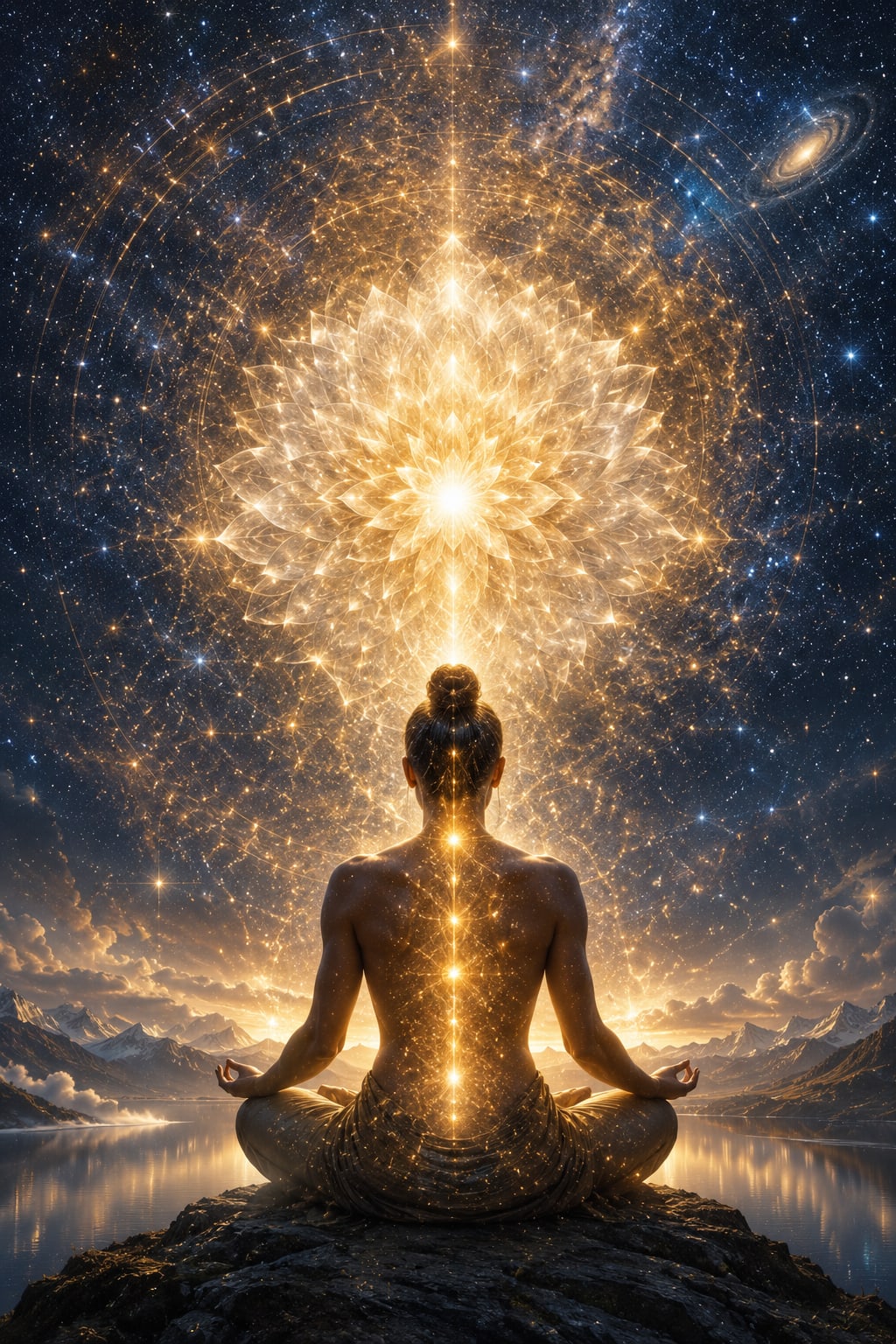
So when the meditation began its climb — mūlādhāra, then svādhiṣṭhāna at the sacrum, maṇipūra at the solar plexus, anāhata at the heart, viśuddha at the throat, ājñā at the brow where the oil had pooled in the morning— by the time it reached sahasrāra, the thousand-petaled crown, there was no resistance left in the line.
The crown opens. A sensation of golden light at the top of the skull; a hollow opening where a moment before there had been a lid; the boundary between inside-me and everything revealed as a fiction rather than a fact. The veil of maya lifted to unity-consciousness.
This is where the insufficient vocabulary can be dangerous. The tradition would call this a moment of mokṣa — release, the drop recognizing the Ocean, again. I enjoy returning to this Ocean as much as possible. Especially in a good boat.
I drank half a coffee that morning. But for the space of a few breaths at the close of that meditation, the small contracted self was dissolved and what stood in its place was vast, still, and blissful. Turīya again. This time it was arrived at from below, carried up a cleared spine on the current the whole day had been preparing.
What the Cleanse Is Actually For
Near the end, Muktan said that after you leave pañcakarma, things don’t stop. The body keeps going. It says: “I want to keep getting rid of the āma — I don’t want to be making it anymore.”
That is the real point, and it is why I distrust my own peak experiences even as I treasure them. The opened crown is not the achievement; it is a demonstration — a brief, vivid proof of what the system can do once the channels are clear and the prāṇa runs true. It shows you the ceiling so you’ll stop mistaking the basement for the whole house.
The house is built by the daily work: the eating, the practice, the not-making of āma, the patient untying of knots on one ordinary morning, and then the next. The roller coaster, Muktan calls it, with the affection of a man who has ridden it fifty years. “The easy path is hard enough.”
I came into the fourth day with a three-day headache and a guilty half-cup of coffee. I left it having touched the crown of my own spine from the inside. The threshold and the bliss are the same doorway, seen from its two sides.
Tomorrow the basti will be easier, and I will hold it longer. The body, having tasted what it is for, tends to cooperate.
Om.
I came to Riverview Spa for a week of pañcakarma under Dr. Michael (Muktan) Sullivan, who has practiced in this tradition for half a century. If your own system has been trying to tell you something — including a headache that won’t quit — this ancient medicine is worth knowing about. One more day for my first panchakarma. Jai!
Om shanti