"Taking It Home"
Swami Hamsananda on Time, Choice, and the Alchemy of Attention

The Only Question That Matters
Swami Hamsananda opened with a question so simple it cuts through decades of spiritual bypassing: “However much time you have left, don’t waste a minute. Not a minute.”
And then the clarification that reframes everything: even eating pizza is not a waste of time. The waste lies elsewhere. It lies in any thought, word, or deed that harms another or moves us further from peace.
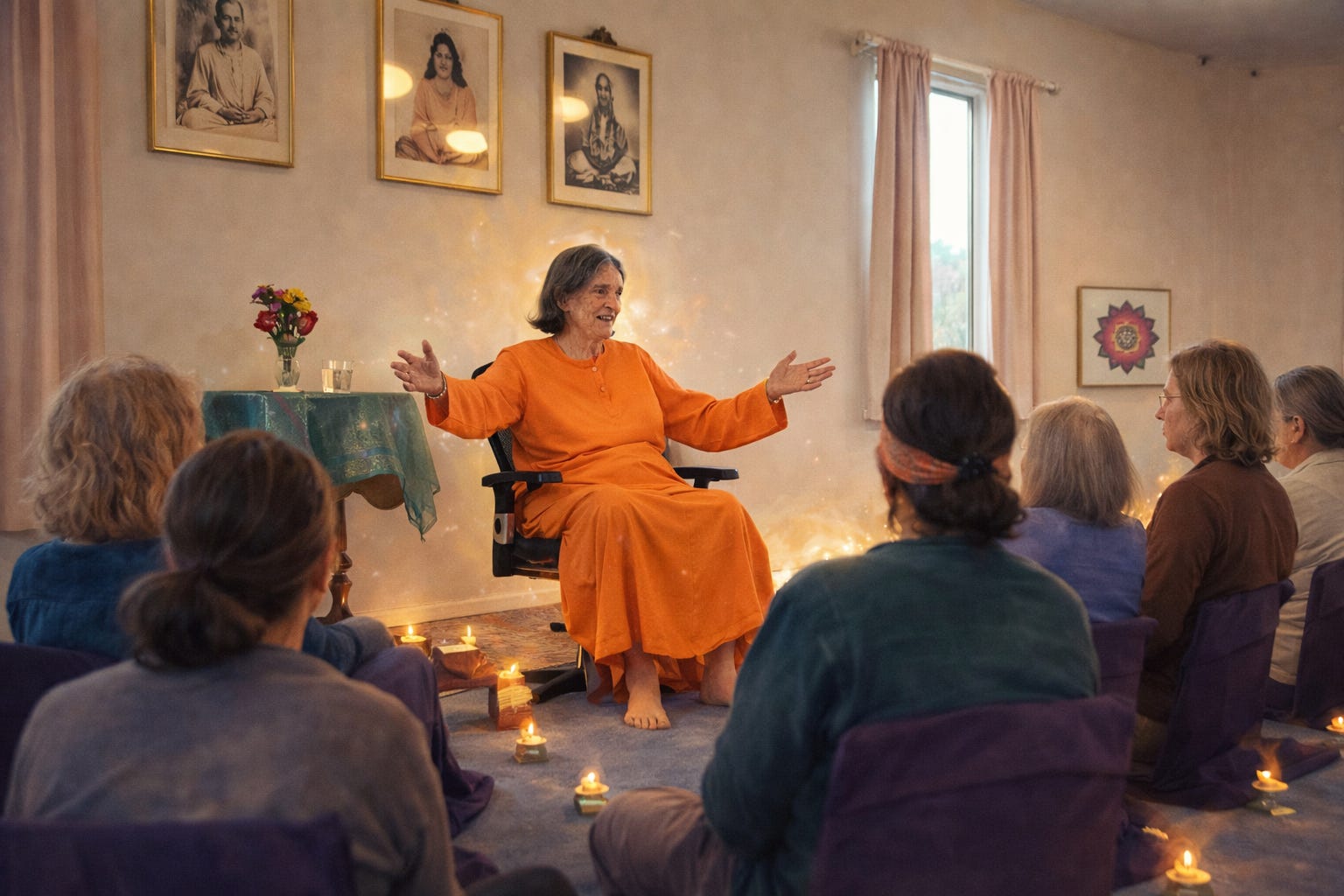
This is the test she offers for every choice: “Will it, if I do this, go there, eat this, buy that, bring me closer to permanent peace and happiness or further away?” The word permanent does the heavy lifting. Temporary pleasures are not prohibited. They are simply recognized for what they are. The yogi does not renounce the world but sees through it, choosing actions whose fruits outlast the moment.
In the Yoga Sūtras, Patañjali distinguishes between preya (the pleasant) and śreya (the good). The pleasant seduces; the good liberates. Hamsananda’s formulation translates this distinction into the grammar of daily decision. Before every action, ask. Before every word, ask. Before every indulgence of thought, ask. The asking itself becomes the practice.
Karma as Conversation
The teaching turned to karma, and Hamsananda offered her characteristic precision: “Every thought, word, and deed, from you and from everyone else, is going to bring a reaction. And it is the law of God.” This is not punishment. This is physics. The universe responds to what we emit. We are always in conversation with consequences we cannot fully trace.
She illustrated with the image of banging one’s head on an open cupboard door while entertaining a negative thought about someone. Coincidence? Perhaps. Or perhaps the architecture of reality is more responsive than materialism admits. The point is not metaphysical certainty but practical vigilance. If every thought participates in shaping what comes next, then the quality of thought becomes the quality of life.
The Bhagavad Gītā calls this karma-phala, the fruit of action. We cannot control outcomes, but we can purify inputs. We can choose, moment by moment, to plant seeds whose harvest we would welcome.
Pratipakṣa Bhāvana: The Yoga of Replacement
When negative thoughts arise, what then? Hamsananda invoked the classical technique: pratipakṣa bhāvana, replacing the negative with its opposite positive. The Yoga Sūtras state it directly: when disturbed by negative thoughts, cultivate the opposite (II.33).
How silly is that? she asked, laughing. How can I make that positive? And yet the technique works not through denial but through redirection. The mind, like water, flows where channels exist. Dig a new channel and the water follows. The negative thought does not disappear through force of will. It fades through disuse as attention flows elsewhere.
This is not toxic positivity. It is neuroplasticity dressed in Sanskrit. The brain literally rewires around repeated patterns. Choose the pattern. Choose the groove. Choose, as the sign she passed reminded her, love.
For Those Living in Pain
A participant asked for advice regarding chronic pain, and Hamsananda paused before responding. The answer, she acknowledged, is not easy.
Several possibilities exist. The pain may be karmic, a purging of past impressions whose intensity now accelerates their release. The pain may also serve others, offering those nearby an opportunity to practice compassion, service, love. We do not always suffer for ourselves alone. Sometimes our affliction is the curriculum for someone else’s growth.
But beyond metaphysics, practical counsel emerged. First, attention matters. The famous water experiment: three glasses, one told I love you, one told I hate you, one ignored. Under the microscope, the loved water crystallized into beauty, the hated into chaos, the ignored into something worse still. If water responds to attention, and we are mostly water, then the quality of our self-talk participates in our cellular reality. Speak kindly to the body, even the body in pain.
Second, pain is inevitable, but suffering is optional. This is not dismissal. It is recognition that the layer of resistance, the I don’t want this, the why me, adds a second arrow to the first. The first arrow is the sensation. The second arrow is the story. We cannot always remove the first. We can, with practice, learn not to fire the second.
Third, read spiritual teachings daily. Hamsananda recommended the Golden Present, a teaching for every day of the year, available freely online. When the mind has something luminous to chew on, it spins less wildly around its pain.
Fourth, smile. Be a smilionaire. The physiology of smiling shifts neurochemistry. The social reciprocity of smiling creates micro-connections that interrupt isolation. The practice is absurdly simple and quietly powerful.
Finally, this too shall pass. Everything passes. The pain will pass, one way or another. Knowing this does not erase the present moment’s difficulty, but it loosens the grip of permanence that makes suffering feel eternal.
V. The Mountaintop
Hamsananda closed by invoking Martin Luther King Jr.’s final sermon: I have been to the mountaintop. She named this as enlightenment, as our shared destiny. The teaching circled back to its origin: however much time remains, don’t waste a minute. Not because life is grim, but because the mountaintop is real, and every moment is a step.
Om shanti