Satsang at the Table
A Yogic Feast of Presence and Connection

Nourishment Beyond the Plate in Community Life
In the quiet heart of winter, a simple dinner becomes a profound sadhana—a spiritual practice—of union, gratitude, and awakening. At The Way Inn, a circle of friends gathers not merely to eat, but to embody the essence of yoga: harmony with the self, with others, and with the divine flow of life.
On Super Bowl Sunday, when millions across the land partake in one of modern society’s grandest collective rituals—a shared spectacle of competition, commercials, and communal fervor—we gathered differently. At The Way Inn, our small circle chose this quiet yogic feast instead, turning away from the screen’s bright distractions toward the deeper altar of presence. In this simple act of devotion, we opened a true portal to samadhi: absorption in the divine through shared prasad and heartfelt sangha. For this grace-filled alternative, we bow in boundless gratitude.
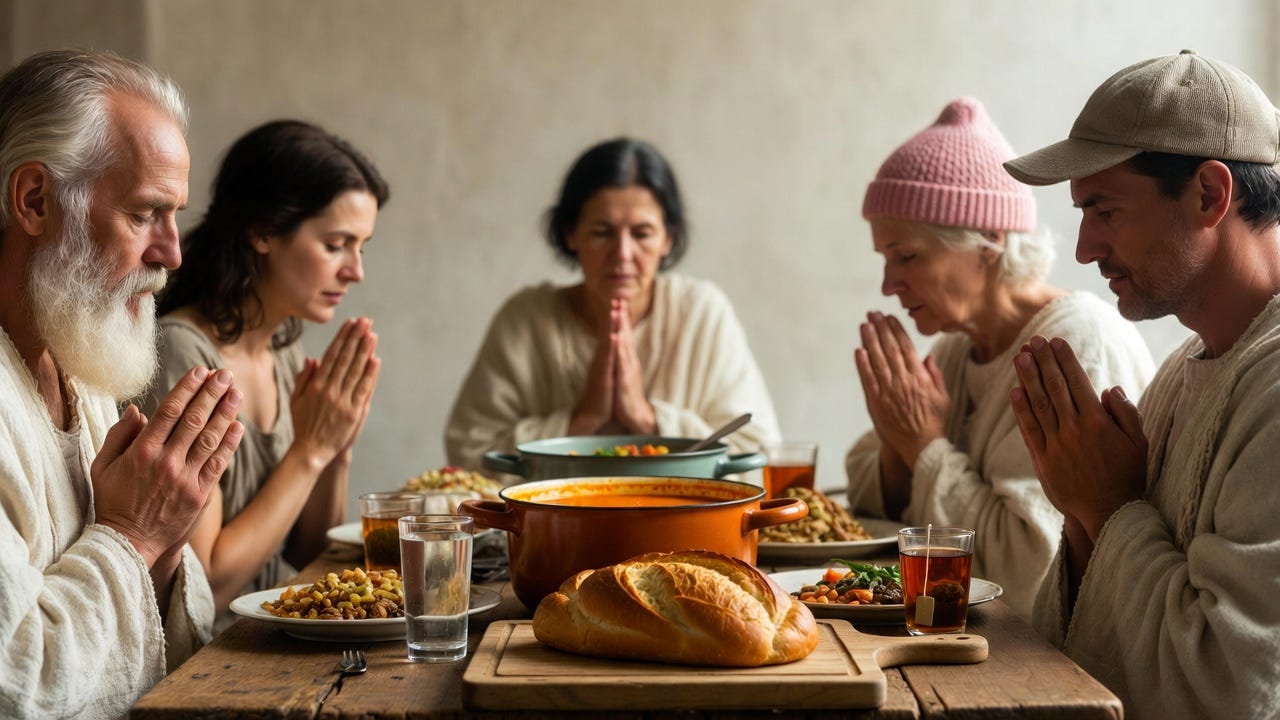
The Sacred Act of Preparation
The evening begins in the kitchen, where hands move with mindful intention. Parsley is chopped for chimichurri, kale steamed, bread baked with care. One friend spends the day crafting cinnamon rolls; another brings quinoa and stir-fry. These acts are not chores but offerings—seva (selfless service) in its purest form.
In yogic tradition, food prepared with love becomes prasad: consecrated nourishment that carries the vibration of the cook’s consciousness. Here, the chimichurri becomes a symbol of spontaneous devotion. The bright orange squash soup—grown by the Swami himself in the house’s garden—along with the homemade bread and roasted vegetables: each dish is infused with sattvic presence, rooted directly in this sacred soil. Such cravings, when followed mindfully, reveal the playful guidance of the inner Self.
The Circle as Sangha
Around the table, bodies settle into bowls rather than plates—a subtle return to the vessel archetype, the grail that receives. Bowls invite a softer, more intimate relationship with food, echoing the yogi’s inner receptivity.
The conversation flows without agenda: stories of Mexican ranches with spinning Lazy Susans, tamale-making parties as communal ritual, plans to travel to Martha’s Vineyard and beyond. Ancestry is shared—Irish, German, Italian, Denisovan traces—reminding all that the human story is one of migration, mixing, and mysterious inheritance. This is sangha in action: spiritual community not confined to meditation halls but alive in shared meals.
In the Yoga Sutras, Patanjali speaks of sattva—purity and harmony—as the quality that reveals light. A sattvic gathering like this clears the mind, softens the heart, and allows truth to surface naturally.
Peaks of Insight: Synchronicity and Cosmic Wonder
Amid the warmth, deeper currents emerge. A story is told of a woman in a meditation class whose highest aspiration was “to pray like Jesus.” Days later, without prior knowledge, she receives the Aramaic word Abwoon (أبون):—the genderless name for the Source—spontaneously arising as her personal mantra. The teachers fell silent in recognition: grace moves in mysterious ways.
Later, astrology and interstellar objects enter the dialogue. A rare celestial visitor, sometimes called 3I/Atlas (or “Thee-Eye Atlas,”) a 10-kilometer intergalactic asteroid, approaches Jupiter, evoking myths of monoliths and evolutionary leaps.
Participants share recent awakenings, sensing a collective quickening. The winter cold outside mirrors the inner stillness required for such openings; the shared warmth inside reflects the fire of transformation.
These moments are darshan: glimpses of the divine. In them, the ordinary dinner reveals itself as a portal.
Gratitude as the Final Course
And lo, from Hanuman’s own hands arise the braided bread and spiraled cinnamon rolls—golden offerings that gleam like the rising sun Hanuman once mistook for a ripe mango in boundless childhood devotion.

Hanuman’s Braided Prasad in Golden Threads
In the ancient Rigvedic hymns, Agni is praised as the divine fire that carries oblations to the gods; here, the oven’s sacred flame has transformed simple grain into living prana, into ambrosial prasad that awakens the inner light.

Hanuman’s Golden Spiral: Cinnamon Roll Mandala
The bread, woven like the cosmic threads of creation, bears the strength of Hanuman’s unswerving service to Rama; the cinnamon rolls, fragrant and coiled, evoke the awakened kundalini rising in sweet ecstasy. Mahavatar Babaji himself, immortal guardian of the Kriya lineage, has been known to manifest simple food as divine sustenance for his disciples—eternal nourishment drawn from the boundless akasha.
Thus these humble gifts, baked with love on this winter day, become a modern yajna: offerings that feed not only the body but the immortal Self, reminding us that in every bite of such consecrated sweetness, the devotee tastes the boundless grace of the Eternal.
As the evening winds down, cinnamon rolls are savored, tea poured, sorbet shared. Leftovers are offered freely; rides home arranged. No one leaves unchanged. The meal has nourished body, heart, and spirit.
In yoga, true satisfaction arises not from consumption but from gratitude. This gathering embodies ahimsa (non-violence) through gentle food choices, satya (truth) through honest sharing, and aparigraha (non-grasping) through generous giving. It reminds us that the highest practice is often the simplest: to show up, to offer what we have, to receive what is offered.
Sutras from the Table
When hands prepare food with love, the meal becomes prasad; the eater and the eaten dissolve into one taste of grace.
In the circle of true sangha, stories are not mere words but threads (sutras) weaving individual souls into the tapestry of the One.
Synchronicity is the divine winking: when the heart’s silent prayer is answered in a stranger’s spontaneous sound.
Winter’s cold presses us inward; shared warmth around a table ignites the inner fire (agni) that melts separation.
The future arrives not through force but through presence: in this moment, at this table, the new world, the age of truth and light (satya-yuga) is already born.
Closing Invocation for a Yogic Feast
After an evening of shared prasad and heartfelt sangha, a fitting yogic closing would honor the meal as a sacred offering while extending gratitude and peace to all beings. The most traditional and resonant choice is the Brahmārpaṇam mantra from the Bhagavad Gita (4.24), which transforms the act of eating into a yajna (sacrifice) where everything—offering, fire, act, and offerer—is Brahman.
Brahmārpaṇam Mantra (Meal Prayer)
(Recite slowly, with hands in anjali mudra.)
Brahmārpaṇam brahma havir
Brahmāgnau brahmaṇā hutam
Brahmaiva tena gantavyaṁ
Brahma-karma-samādhinā
The act of offering is Brahman.
The offered food is Brahman.
It is offered by Brahman into the fire of Brahman.
Brahman alone is attained by one who sees Brahman in all actions.
Followed by Universal Peace Invocation
(Then, to radiate the blessings of the gathering outward:)
Lokāḥ samastāḥ sukhino bhavantu
Lokāḥ samastāḥ sukhino bhavantu
Lokāḥ samastāḥ sukhino bhavantu
(May all beings everywhere be happy and free.)
Closing Mantra
Om pūrṇam adaḥ pūrṇam idaṁ
Pūrṇāt pūrṇam udacyate
Pūrṇasya pūrṇam ādāya
Pūrṇam evāvaśiṣyate
Om śāntiḥ śāntiḥ śāntiḥ
(Īśā Upaniṣad: That is whole, this is whole. From the whole the whole arises. Taking the whole from the whole, the whole alone remains. Om peace, peace, peace.)