Right Relationship with Agni
Musings Before the Community Fire Safety Meetings

Fire Safety Meeting: 10am, Sunday, May 17, 2026 @ 76 The Way, Yoga Shala Community Room. Hosted by By Erik & Galen (Swami Nityananda)
A Meeting Whose Time Has Come
This Sunday, Galen and I will host an open Fire Safety Meeting for the Village Sangha Association and the wider Yogaville community. The occasion is practical and pressing. Virginia is dry. Several local fires have already moved closer to us than is comfortable. Equipment is sparce, communication channels are uncertain, and most of us have no formal evacuation plan beyond the assumption that someone, somewhere, will tell us what to do.
The meeting will cover what such meetings cover: prevention, preparedness, equipment, phone trees, evacuation considerations, training. These are not small matters. Rural fire is fast, and a community without a plan is a community at the mercy of luck. We need the practical conversation.
But I find that I cannot quite walk into this gathering without first sitting with a deeper question — the question that the meeting itself, taken at the level of symbol, is silently asking. And so I write this short essay as a way of preparing, of clearing my own ground before the conversation begins.
The question, simply put, is this: what is our right relationship with Agni?
Two Fires, One Flame
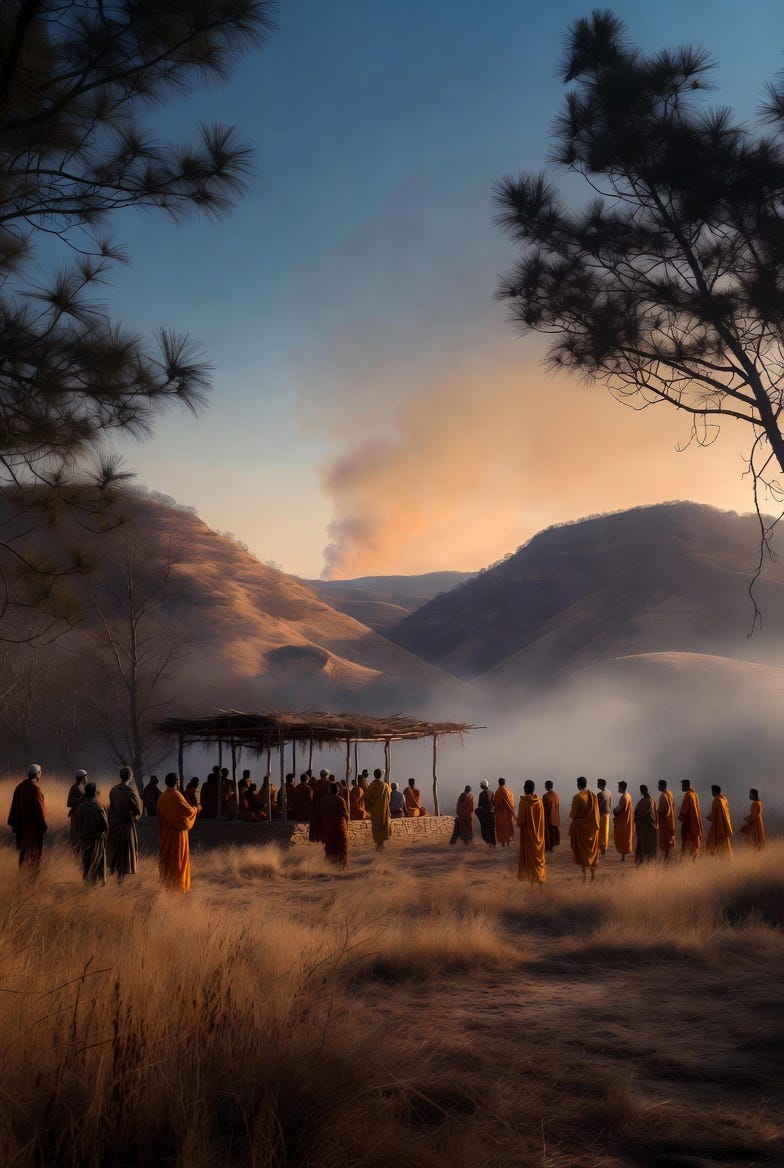
The yogic tradition has always insisted that the fire in the world and the fire in the body are not two different fires. They are aspects of one Agni — one cosmic principle of transformation that manifests in the hearth, the lightning, the sun, the volcano, the metabolism, the breath, the discerning mind, and the meditative absorption that knows itself as light. The Vedic seers did not separate the literal flame from the symbolic flame. They considered them continuous. The fire on the altar and the fire in the heart were the same Agni, taken at different scales of manifestation.
More than poetry, this is precise observation. Drought is also a condition of consciousness. A community without warmth, without circulation, without genuine encounter, dries out long before its forests do. And when the conditions are right — when the soil is parched and the wind is up and a single spark finds the right tinder — the outer fire arrives almost as a consequence of the inner one. The Earth, our seers would say, is presenting us with a mirror.
So when we gather Sunday morning to talk about fire safety, we are gathering, whether we name it or not, on yogic ground. We are asking, together, how to be in proper relationship with the most ancient and most powerful principle the tradition recognizes. This is no ordinary civic meeting. This is a yajña — an offering — disguised as a planning session.

Right Relationship with Agni
What does right relationship with Agni look like? Three things, I think.
First, respect. Fire is not an enemy. Fire is the oldest priest, the purohita — literally, “the one placed in front” — and our ancestors knelt before it because it had earned that station. To respect Agni is to recognize that fire will do what fire does. It will consume what is dry. It will burn what cannot withstand its heat. It will purify what needs purifying, whether we invited the purification or not.
A community in right relationship with Agni does not pretend that fire can be controlled by wishful thinking. It plans. It clears brush. It maintains its equipment. It builds firebreaks both literal and metaphorical.
Second, intimacy. Fire is not only to be respected from a distance. It is also to be tended close. The yogi’s relationship with Agni is not avoidance but cultivation — keeping a small fire steadily burning, every day, so that one is never a stranger to the flame. This is what daily sādhanā is. It is what the morning candle, the evening lamp, the agnihotra, the kitchen stove, the conversation around a fire pit all do at the level of practice: they keep us on familiar terms with the principle of transformation. A people who have lost the habit of tending small fires will be terrified of large ones. A people who tend their fires daily can meet the larger fires with the steadiness of long acquaintance.
Third, surrender. This is the hardest piece The Bhagavad Gītā says of the true Self: nainaṁ chindanti śastrāṇi, nainaṁ dahati pāvakaḥ — weapons do not cleave it, fire does not burn it. This verse is not a denial of the body’s vulnerability. The body burns. Anyone who has watched a house go up knows this with a clarity nothing else provides. The Gītā’s point is subtler: at the deepest layer of what we are, there is something fire cannot touch. The witness is unburnable. The puruṣa is beyond all the elements. To know this, even in glimpses, is to be relieved of the particular terror that makes us either reckless or paralyzed before fire’s possibility.
This is not a doctrine to be deployed in lieu of practical preparation. It would be a perversion of the teaching to say I do not need a fire extinguisher because I am the Ātman. The body is the temple, and the temple deserves care. But the underlying recognition — that the deepest center of who we are is not subject to destruction — gives us the equanimity to plan well, to act decisively, and to not panic. Equanimity is not the opposite of preparation. It is what makes preparation possible.

What “Safety” Means, Considered Yogically
The English word safety comes from the Latin salvus, meaning whole, unharmed, sound. In Sanskrit, the corresponding ideas cluster around kṣema (security, well-being) and, deeper still, abhaya — fearlessness. The yogic tradition is unusually clear that true safety is not the absence of danger. Danger is a feature of embodied life, not a bug. True safety is the absence of fear in the presence of danger — the steadiness of one who knows their own ground.
Read this way, a fire safety meeting is a kṣema sādhanā — a practice of communal security in the deeper sense. We are not only listing equipment and routes. We are, together, doing the inner work that makes a community capable of meeting fire — or any other manifestation of prakṛti‘s power — without losing its center. Each phone-tree call, each conversation about who needs help evacuating, each shared meal that follows the meeting, is adding to the collective abhaya of the village.
This is why I want us to gather in person, in the same room—at Agni Shala — The Hall of Sacred Fire, rather than only by email. The fabric of community is woven from face-to-face encounter. Phone trees work because the names on them are people we know. Evacuation plans work because the neighbors we are coordinating with are neighbors we know and share meals with. The fire safety conversation is, at its root, a conversation about the strength of the social weave, the living sutras. And no electronic substitute will produce the warmth that face-to-face presence produces.
The Circle Around the Fire
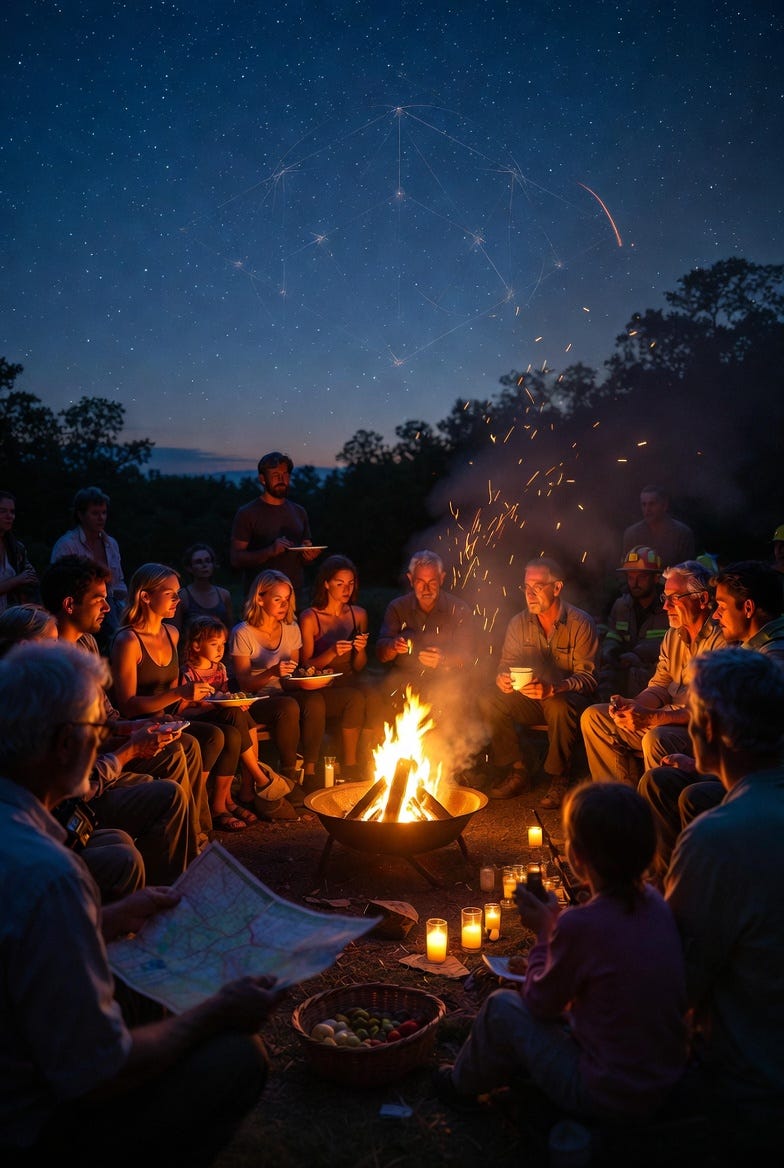
There is an older form for this kind of gathering. Before there were meeting rooms there were fire-circles. The fire in the center did several things at once. It gave light to see one another’s faces. It gave warmth to make sitting together pleasant. It gave a shared focus that kept the conversation from scattering. And it provided a continuous, silent reminder of the very thing being discussed: the principle of transformation, sitting calmly in the middle of the circle, behaving itself because it was being properly tended.
I would love to hold a future iteration of this meeting around an actual fire pit. There is something particular that happens when human beings gather around flame — a quieting of the chatter, a softening of the posturing, a return to a more ancient mode of being together. The conversation we will have around fire safety will not be the same conversation we would have under fluorescent lights. The fire itself becomes a teacher.
For Sunday, the Yoga Shala Community Room will be our hearth. But let us bring some of that fire-circle quality to the gathering. Let us speak more slowly than we are used to. Let us listen for the unspoken concerns that the words are pointing toward. Let us treat each other as fellow tenders of a single flame.
What Would Dr. Frawley Say?
I found myself asking this question on a long run today, after my mind had quieted enough for it to surface. What would David Frawley — whose work on Agni and the sacred fire informs so much of what I think about all this — actually counsel a small community at this exact moment of evolutionary crisis?

I suspect his answer would have several parts:
He would say: yes, prepare practically. The body and the village are real, and prudence is a form of devotion. Have your bags packed. Know your routes. Maintain your tools. Clear your brush. Trust the firefighters and pray for them.
He would say: and recognize that you are being addressed. The drought is a teacher. The proximity of fire is a teacher. The Earth is trying to get the human family’s attention, and a community that is already in some form of contemplative practice is better positioned than most to actually receive the message rather than dismiss it as weather.
He would say: cultivate your inner Agni so that the outer Agni does not find you depleted. Daily practice — meditation, prāṇāyāma, mantra, simple ritual — keeps the internal fire steady. A community of yogis with steady inner fires will be a community capable of meeting an outer fire with composure and competence rather than panic and recrimination.
And he would say, I think: let this be the beginning of a longer conversation. One meeting, however well attended, is not the answer. What we need is a sustained, season-by-season, year-by-year reweaving of our relationship with Agni at every scale — from the morning candle to the planetary climate. Sunday is part of an ancient, ongoing, tradition, not a culmination.
A Practical Yogic Preparedness
In that spirit, here is a sketch of what yogic emergency preparedness might look like at the level of daily practice. None of this replaces the practical infrastructure the meeting will discuss. All of it complements it.
Daily tending of the inner fire. Morning meditation, even briefly. The maintenance of internal steadiness is its own form of community service.
Daily attention to digestion and rest. Jaṭharāgni and prāṇāgni — digestive and respiratory fires — are the foundations of physical resilience. A community whose members are well-rested and well-fed makes better decisions under stress.
Weekly community contact. Calling, visiting, sharing a meal. The phone tree is only as strong as the relationships it traces.
Seasonal awareness. Knowing where in the year we are, what the land is doing, what the wind patterns suggest. The old farmers knew this. The yogis knew this. We have to relearn it.
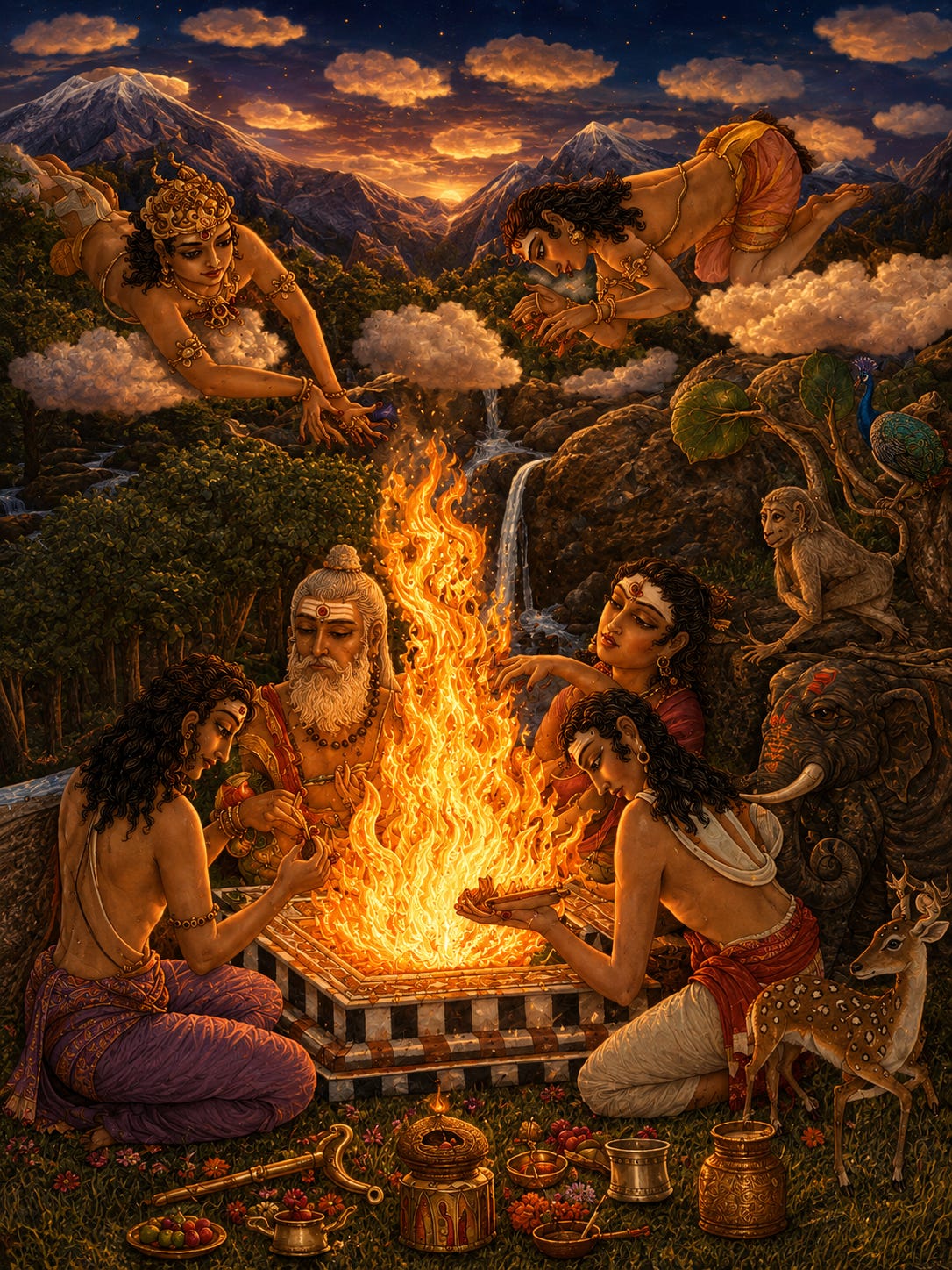
A small ritual relationship with flame. A candle on the altar, a lamp at sundown, an occasional fire in the pit. These are not decorations. They are how a household stays on speaking terms with Agni.
Equanimity practice. Whatever form works — vipassanā, prāṇāyāma, mantra, devotional song — the inner work that develops abhaya, fearlessness, so that when the moment of decision arrives we act from clarity rather than panic.
A community that practices in these ways before the emergency arrives will not be saved by its practice. But it will be capable — and capability, in the yogic understanding, is precisely the fruit of sustained practice.
Invitation
This Sunday, May 17, from 10 AM to noon, I hope to see you in the Yoga Shala Community Room at 76 The Way. Bring your questions, your concerns, your equipment knowledge, your stories, your grievances, your petitions, your hopes. Bring what you know about emergency preparedness, and bring what you do not yet know. Bring yourself, fully — that is the essential offering.
Galen and I will hold the structure of the gathering, but the meeting itself belongs to the community. Whatever wisdom emerges will emerge from the room. The most important outcome is not a finished plan. It is a quickened sense, a inner fire, an urgency, in all of us, that we are participating together in something older and larger than ourselves — the long human practice of right relationship with the sacred fire.
May we meet Agni well. May we tend our inner flames steadily. May the village be safe in every sense the word can hold.
Oṁ Agnaye Namaḥ.


Erik is a program coordinator at AgniWellCare (The Sacred Fire of Wellness & Care, the new nonprofit at The Way) and the new Programs Coordinator at Satchidānanda Āśram–Yogaville.
om shanti