Maintenance Tapas: A Run Before Panchakarma
The 1% Body, the Long (20-Mile) Run as Continuous Bhūtajaya, and the Eco-Yogic Threshold of Pañcakarma

1. The Friday Scene
Tursday afternoon. The ghee is cooling on the counter — four pounds of Amish butter reduced through that slow alchemy the tradition calls ghṛta, the most refined of fats, the substance Āyurveda regards as more itself the older it gets. Monday it goes into the kitchari of pūrvakarma. The daily abhyanga has begun: warm sesame, slow hands, the priming of the outer surface while the inner currents are coaxed toward simplicity. Monday I lie down at the clinic and the formal protocol begins.
Friday afternoon, the body ran twenty miles. Two hours fifty-five minutes, 8:43 pace, 764 feet of elevation through the Virginia Blue Ridge Railway Trail. Dr. Sullivan — the first physician I have consulted in over two decades — recommended ten or fifteen. He said the recovery cost of a full marathon-effort run is substantial, and that one would receive more from pañcakarma if they came in with a body closer to its constitutional baseline. He was reasoning, properly, about a marathon-effort twenty-six. He was not reasoning about what the run actually was.
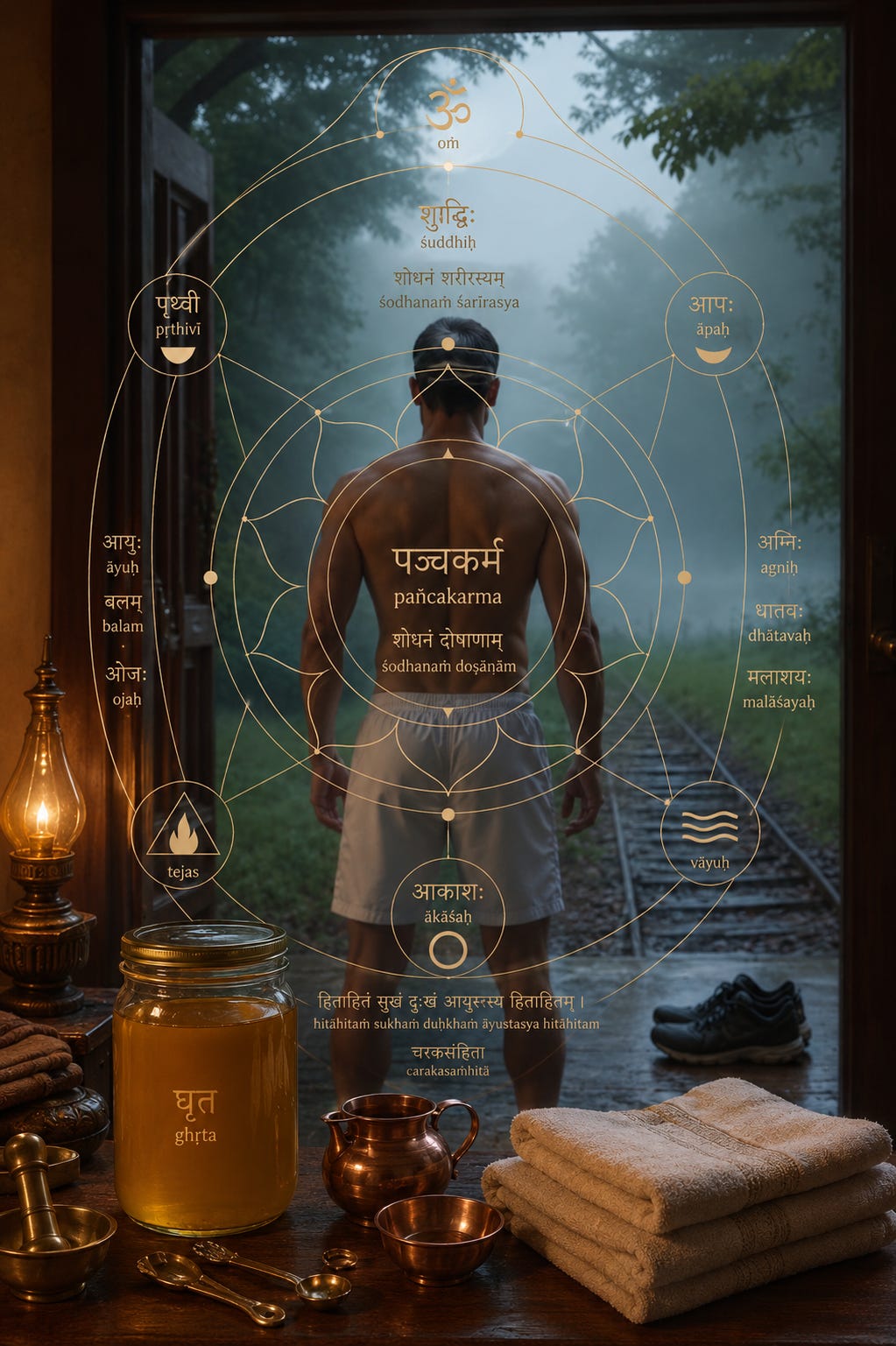
A “Three-Quarter” Marathon
Because the run was not strenuous. It was unhurried. At mile twenty the body could have continued to twenty-six, to thirty, with no felt cost. The pace stayed conversational throughout. I returned more energized than I left — neurochemically replenished, autonomic tone restored, the long-aerobic refreshment that the trained system produces when operated within its working range rather than at its edge. I compromised at twenty rather than at twenty-six because two forms of knowing were in dialogue, and twenty was the figure at which both could rest.
This essay is about that dialogue, about the body that has it, and about the way that body arrives at the threshold of pañcakarma — not depleted but already in continuous purification.
2. Two Pramāṇas: The Physician’s Counsel and the Body’s Knowing
The compromise was the integration of two legitimate sources of knowledge. Classical yoga calls them pramāṇa — the right means of knowing — and Patañjali, in I.7, identifies three: pratyakṣa (direct perception), anumāna (inference), and āgama (testimony from a qualified source). The physician’s counsel was āgama refined into anumāna: testimony from medical tradition applied through clinical reasoning to my particular case. The body’s knowing was pratyakṣa: direct perception, refined through twenty years of long-distance running and twenty-six years of trad climbing into a finely calibrated reading of what this body can do today.
It matters that Dr. Sullivan is the first physician I have consulted in twenty-some years. Not from avoidance — from sufficiency. The body has been its own teacher, and the teaching has held. The clinical relationship initiated this season was undertaken with the seriousness that such a long-deferred opening deserves: I trust this physician’s reasoning, his Āyurvedic training, his assessment of what this particular cleanse asks of a particular body. And I trust the body I have been listening to for twenty years.
Patañjali does not rank the pramāṇas. He lists them. The mature practitioner holds them simultaneously and triangulates. Where they converge, certainty deepens. Where they diverge, the practitioner inquires further. Dr. Sullivan’s anumāna said less effort. The body’s pratyakṣa said the body is ready for considerable effort, run at moderate intensity. The convergent figure was twenty — beyond the conservative counsel, beneath the body’s capacity, and well below the marathon-effort threshold the physician was rightly cautioning against. The compromise was not a negotiation between two egos; it was integrated pramāṇa.
3. Kāya-Sampat: The 1% Body Reframed
There is a sentence that has been circling these last days, and it deserves precise treatment: I want a 1% body, not a “normal body.” Read carelessly, the sentence sounds like asmitā — the ego identifying with its instrument. Read carefully against the classical tradition, the sentence names something the tradition has its own vocabulary for.
The Vibhūti-pāda of the Yoga Sūtras, in III.45 — the sūtra Article 4 develops at length — explicitly identifies kāya-sampat as among the fruits of bhūtajaya saṃyama: perfection of the body, alongside the siddhis of aṇimā and the rest. The classical tradition assumes that sustained yogic practice produces a body that operates beyond ordinary functional range. This is not vanity. It is the documented developmental arc of integrated practice. The contemporary fitness vocabulary describes this same body in statistical-comparative terms — top one percent, top one in a thousand, top one in ten thousand — because contemporary measurement is statistical and comparative. The underlying phenomenon is what the tradition has long named.
The distinction that matters is not whether the body is exceptional but the relationship to its exceptionality. Kāya-sampat held as identity becomes a subtle attachment; the Yoga Sūtras themselves caution that the siddhis can become impediments if they are clung to. Kāya-sampat held as instrument — the refined vehicle through which the deeper sādhanā proceeds — is what the tradition values and what the integrated discipline cultivates. The 1% body, in the second framing, is not the goal but the substrate. It is the vāhana — the vehicle — that long practice has shaped, on which the further work travels.
The vocabulary matters because the relationship matters. Statistical-comparative language tilts toward identity; classical kāya-sampat language tilts toward instrumentation. The body is the same; the orientation differs. The athlete-yogi who recognizes the developed body as instrument rather than as achievement holds it more lightly, uses it more skillfully, surrenders it more cleanly to the deeper practices it makes possible.
4. Running as Continuous Bhūtajaya
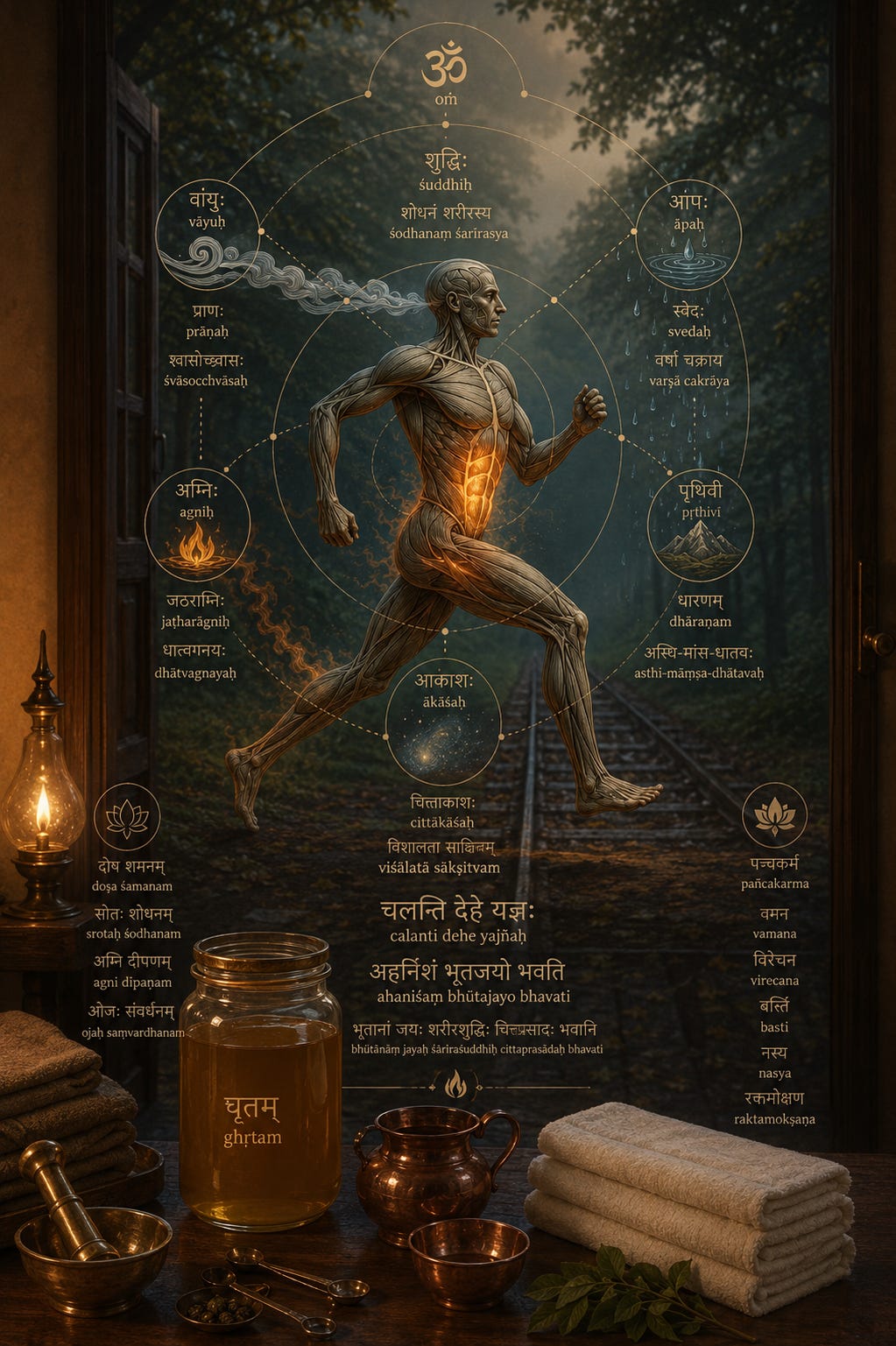
In my Panchakarma Series, Article 4 develops the bhūtajaya saṃyama curriculum — the five-aspect engagement with each of the five mahābhūtas — as the foundation of Eco-Yoga. The personal application has not yet been made, and it deserves making: the long run, for the trained practitioner, is a coordinated practice on all five elements simultaneously.
Pṛthivī in the long run is the twenty thousand footstrikes between mile zero and mile twenty, each a brief saṃyama on density, support, gravitational return. The runner’s body becomes intimate with the soil through the feet in a way that the sedentary body never does. Sthūla: the soil itself, the bedrock beneath the trail. Svarūpa: the principle of structural support. Sūkṣma: the gandha-tanmātra of damp Virginia ground on a rainy and misty day in May. Anvaya: the soil holding the water that the morning’s rain has begun to release. Arthavattva: the substrate without which no further manifestation occurs. Twenty miles of footstrikes is twenty miles of saṃyama on earth.
Āpas in the long run is sweat economy, hydration management, the body’s water-tuning as a real-time saṃyama on the principle of cohesion. The runner who has trained for years has developed a refined relationship to the rasa dhātu that the sedentary body cannot achieve through any short course of practice. The cooling that the sweat permits, the electrolytic regulation that proceeds across the duration, the way āpas leaves the skin to enter the air and return to the watershed — these are not metaphors. They are the literal operation of water at this scale of organization.
Agni in the long run is metabolic rate elevated and sustained, thermoregulation engaged, the body’s fire mobilized in coordinated cycling. The trained athlete’s agni is a particular kind of well-banked fire — high in capacity but low in volatility, capable of sustained combustion without sharp spikes or sharp depletion. The long run is a saṃyama on transformation: glucose to ATP, fat to ATP, oxygen carried by hemoglobin to mitochondria across thirty kilometers of capillary bed.
Vāyu in the long run is breath cycling at controlled intensity for nearly three hours. The runner who can sustain 8:43 pace over twenty miles is a practitioner of prāṇāyāma in motion. The breath-to-stride ratio that experienced runners develop — typically 3:2 or 2:2 at moderate effort — is a continuous coordination of vāyu with pṛthivī, breath with footfall, in a precision that few seated prāṇāyāma practices achieve at this volume.
Ākāśa in the long run is the spaciousness of long aerobic effort, the field within which the discursive mind drops out and what remains is the rhythm of breath and step. The runner’s quiet is well-documented under the contemporary names — default mode network quieting, transient hypofrontality, endogenous opioid and endocannabinoid release, the so-called runner’s high. The classical name is dhāraṇā deepening into dhyāna deepening into states that occasionally cross the border into the absorptive. The long run is, for those who can stay attentive across the duration, a portable monastery.
Twenty marathons over twenty years is twenty years of integrated five-element practice. The athlete-yogi who recognizes the running as bhūtajaya gains the framework within which to receive the deeper bhūtajaya that pañcakarma supports. The naming clarifies the practice. The practice was already underway.
5. The Portable Yajña
Article 4 reframes pañcakarma as contemporary yajña — the body as homa-kuṇḍa, the cleanse as ritual fire-offering through which the elemental cycles are participated in rather than disrupted. The long run, on the same reading, is the moving yajña: the body offered into the elemental cycles in a distributed form across the duration of the practice.
The exhaled carbon dioxide that the run produces, cycled into the chlorophyll of the Buckingham hardwoods through which the trail passes, is agni-yajña in continuous form. The oxygen received back from those same hardwoods, drawn into the lungs at six breaths per twelve strides, is agni-yajña received. The sweat returned to the air as the body cools is āpas-yajña — water given back to the watershed in evaporative form, eventually returning to the same hills as rainfall. The footstrike on Virginia soil is pṛthivī-yajña — the body’s weight transmitted into the substrate, the substrate’s reaction force transmitted back into the body. The motion through the spring morning air is vāyu-yajña — the body and the wind exchanging their relative positions, the body and the wind acknowledging one another at the surface of skin. The wide attention that the long run produces is ākāśa-yajña — the field of awareness opened to receive what the duration brings.
This is not metaphor. It is the literal continuous exchange that the runner’s body enacts. What the classical Vedic ritualists coordinated through the fire-altar — the formal offering of refined substance into the agni-medium for transformation and return — is what the embodied practitioner in motion enacts in distributed form across landscape. The runner is the moving homa-kuṇḍa, the daily yajamāna, performing the five-element offering across the local watershed in a form that the classical period would have recognized had they encountered the practice. Pañcakarma is the formal coordination of these offerings under clinical supervision; the long run is the distributed practice of the same offerings under embodied attention.
And the offering returns. The runner who completes the long run is replenished — neurochemically, autonomically, structurally. The cleanse that the run performs at distributed scale leaves the body more itself, not less. Agnihotra of the body’s metabolic fire stokes and clears in the same act. This is what the Article 4 thesis means by the body-cosmos homology made operational: the same regulatory motif at body and at landscape, instantiated through the same elemental dynamics, performed in continuous low-grade form by the embodied athlete-yogi between the more intensive cycles of clinical pañcakarma that the larger discipline coordinates.
6. Maintenance Tapas
The phrase to hold is maintenance tapas. The body that operates at the 1% functional level cannot be sustained at sedentary effort levels. Maintaining the kāya-sampat that long practice has produced requires the disciplined effort that produces and sustains it. This is not the pathology of striving. It is the constitutional requirement of a body that has been trained into a particular range.
There is a recurring conceptual error in contemporary discussion of athletic discipline that the yogic vocabulary can help clarify. The error is to read sustained high-level practice as sustained high-intensity effort. They are not the same. Maintaining a top-decile aerobic capacity at age 41 does not require running at top-decile effort every day. It requires running, climbing, breathing, eating, and sleeping at the intensities and frequencies that a body in this range has integrated. The twenty-mile run at 8:43 pace is, for a body trained to this level, maintenance pace — the equivalent of an unhurried walk for a sedentary body. The pace that would deplete the trained body is not 8:43; it is the marathon-effort threshold that begins around 7:00 and that Dr. Sullivan was rightly cautioning against.
Tapas at the maintenance level of a 1% body is therefore not extremity. It is the daily-weekly-yearly disciplined engagement that sustains the body in its trained range. This is the tapas the classical tradition describes: not the heroic outburst but the consistent flame, the agnihotra kept across the years rather than the spectacular conflagration. Higher expectations require higher tapas precisely because they are higher expectations, not because the tapas must always be heroic. The flame is steady. The flame is what the level requires.
The discipline that maintains kāya-sampat across decades is, on this reading, structurally identical to the discipline that maintains any well-tuned system — the soil microbiome of a regenerative farm, the watershed of a stewarded valley, the sangha coherence of a practicing community. Each requires its own characteristic frequency of attention, its own characteristic intensity of engagement, calibrated to what the system actually needs to remain itself. The eco-yogic principle is general: maintained excellence in any nested-process system is the fruit of sustained appropriate practice at the system’s appropriate intensity. The body at this level is one instance of that principle.
7. The Threshold, Re-Read
The threshold the body crosses on Monday morning is not the threshold of a body coming to pañcakarma depleted. It is the threshold of a body coming to pañcakarma primed. The continuous bhūtajaya of maintenance running, the portable yajña of long aerobic exchange with landscape, the kāya-sampat that twenty years of integrated practice has produced — all of this arrives at the clinic on Monday morning and lies down on the table to receive what the deeper protocol can offer that the distributed practice cannot.
This re-reading of the threshold has a practical consequence that warrants explicit naming. The pañcakarma the trained athlete-yogi receives is not the same protocol that an untrained body would receive, even if the procedural elements are formally identical. The trained body brings a different substrate. The agni is well-conditioned. The vāyu is regulated. The pṛthivī is structurally maintained. The ākāśa has been cultivated. The cleanse can therefore go deeper than it could in a body that has not done the distributed work, because the distributed work has been done, and what remains is the strata of accumulation that only a clinical protocol of this scope can reach. The maintenance practice prepares the substrate on which the clinical practice operates.
The Eco-Yoga framework places this bodily discipline alongside contemplative, communal, and ecological engagement as concurrent quadrants of integrated practice. The long run before pañcakarma is the bodily quadrant in its distributed phase. The clinical cleanse is the bodily quadrant in its concentrated phase. The Eco-Yogic athlete moves between the two cycles as the seasons of practice require: distributed and concentrated, daily and seasonal, mile-by-mile and protocol-by-protocol. They are not opposed. They are the same practice operating at different temporal scales of the same continuous bhūtajaya.
The shoes are by the door. The ghee is on the counter. The oil is on the skin. The threshold is two days away.
The body that crosses it on Monday is the Earth-body in local concentration, already in continuous purification, arriving to receive the deeper cycle of the same practice the running has been performing all along. The cleanse will deepen what the running has done. The running will resume after the cleanse with the depth the cleanse has added. The watershed will continue to receive what the body offers, and the body will continue to receive what the watershed returns. Yathā piṇḍe tathā brahmāṇḍe. As in the body, so in the cosmos. The athlete-yogi participates in the elemental cycling of the living Earth by maintaining the elemental cycling of the local concentration of prakṛti the body is.
This is the practice. Maintained at the level the body has been trained to. Offered into the cycles the cycles are. Received back in the form the cycles return.
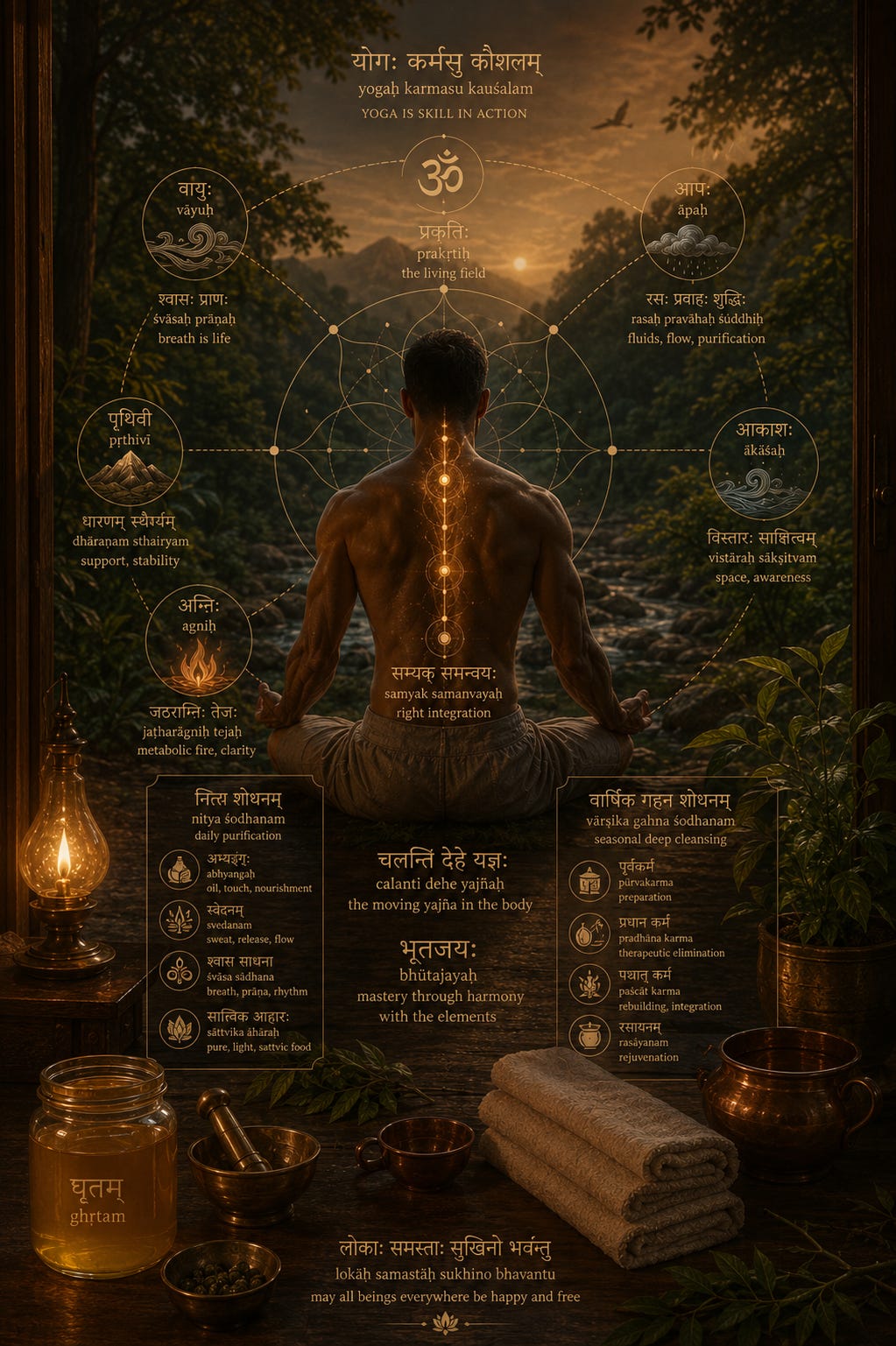
Oṃ śāntiḥ śāntiḥ śāntiḥ.