Every Morning Is Easter
The Yogic Understanding of Resurrection and the Path Through Suffering

On the evening before Easter, the Satsang began with a beautiful kirtan.
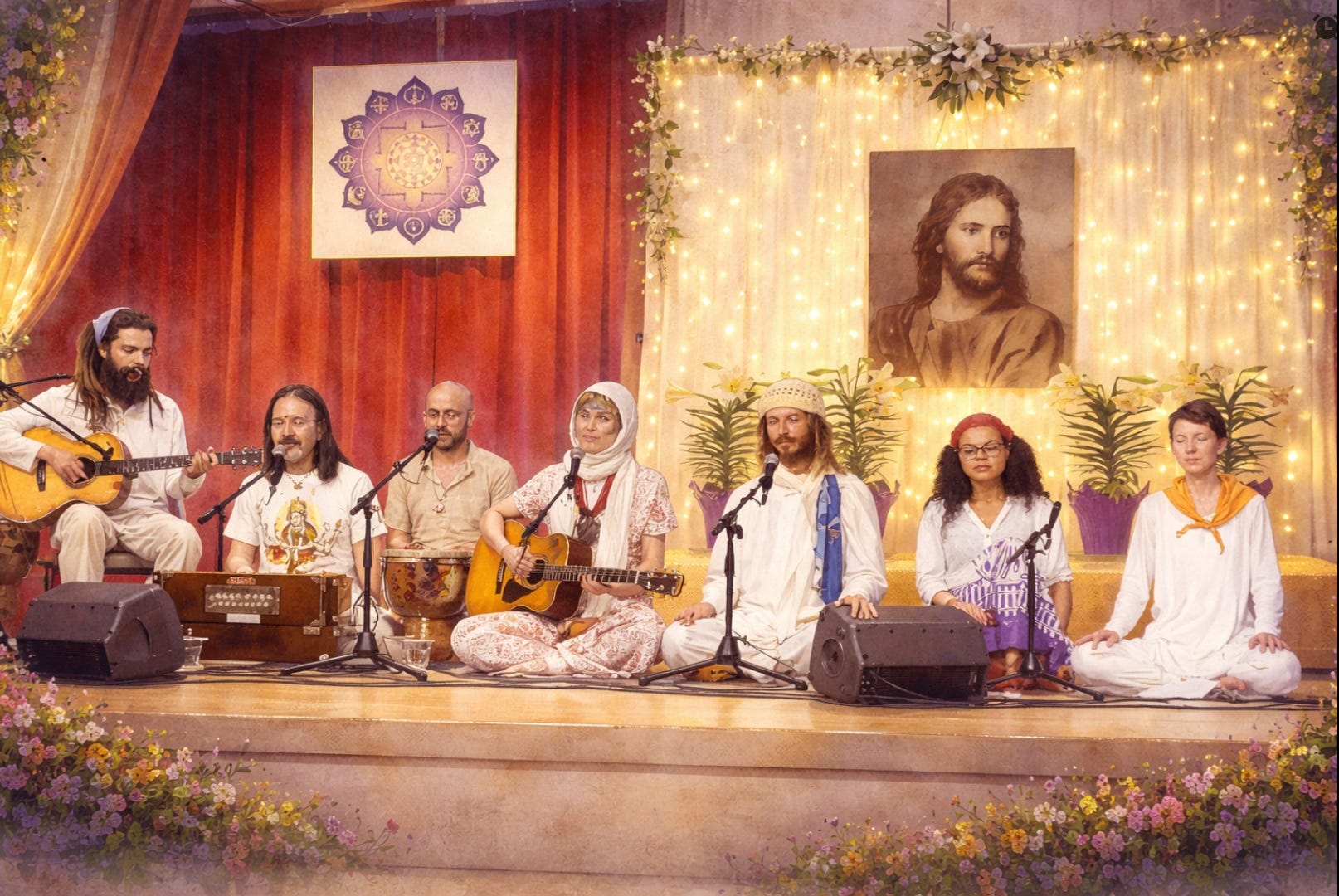
What if Easter is not a miracle that happened once—but something that happens every morning?
Each night, you disappear. The world vanishes. The body becomes inert, almost like a corpse. And yet, at dawn, something returns—not as a resurrection of the body, but as the reappearance of consciousness itself. In this sense, the yogic sages would say: Easter is not rare. It is constant. The question is not whether resurrection happens—but whether we recognize it.
This was the teaching offered on Saturday evening, at Satchidananda Ashram, the night before Easter, as two senior teachers illuminated the ancient wisdom that underlies the Christian celebration. What emerged was a deepening interpretation —a lens through which the resurrection of Christ becomes not a singular exception to the laws of nature, but a revelation of what those laws actually are.
The Sleep That Reveals
“Death is like going to sleep,” Swami Satchidananda began, quoting the Tamil saint Thiruvalluvar. “Birth is like waking up in the morning. See how he simplifies birth and death.”
This reframing asks us to notice what we have always ignored: that every night, in deep sleep, the body becomes functionally indistinguishable from a corpse. If you sleep well, “even if somebody kicks at your body, you won’t even know.” The awareness that animates you withdraws completely. The world ceases to exist. And yet, at dawn, you return.
“In that sense,” he continued, “every day we should be celebrating Easter. Thanking God and nature for giving us a new birth.”
Paramhansa Yogananda makes a similar observation in The Second Coming of Christ, noting that “a soul during sleep is not conscious of its physical body. Likewise, a soul after death is not conscious of its astral and causal bodies sleeping the unconscious sleep of death.” The parallel is not metaphorical but structural: sleep and death differ in degree, not in kind. What we call resurrection is simply a more dramatic instance of what we call waking up.
But if resurrection happens every morning, why do we not experience it as miraculous? The answer lies in our failure to recognize what actually returns. We assume it is the body that wakes—the same collection of molecules that fell asleep. But this is precisely backward. The body does not wake the spirit. The spirit wakes the body. And the spirit, as the Bhagavad Gita insists, “cannot be cut, burnt, wet or withered.”
The Jail We Mistake for Home
If the spirit is what we truly are, then our identification with the body constitutes a kind of imprisonment. The teacher did not soften this point:
“Living in this body is not really a great thing. We are bound. We are tied. Neither ourselves nor others seem to experience the charm and the beauty and the strength and the power of the spirit. It’s a jail. You are confined to this body. It limits you.”
This is difficult teaching for a culture that worships physical health and dreads physical death. Yet the teacher was not advocating neglect of the body or premature escape from it. He was pointing to a shift in identification—a recognition that the body is a vehicle, not a driver. The flame is not the lamp. The self is not the flesh.
“If you know the truth,” he continued, “you will be happy to wait for the day when you just get out of the jail, this prison, so that you can go around wherever you want, do whatever you want—or whatever God wants you to. You don’t have to go through the electronic devices to fly. No bombs can harm you. Just fly as a free bird.”
This is the Easter promise translated into yogic terms: not merely survival after death, but liberation from the conditions that make death fearful in the first place.
Why Only Some Could See
A subtle theological question arose: if Jesus truly rose from the dead, why didn’t everyone see him? The Gospels record only scattered appearances to specific disciples. Skeptics treat this as evidence against the resurrection. The yogic tradition offers a different reading.
“If he has come up with the same physical body, everybody should have seen him,” the teacher observed. “Only a few who were devoted were able to see. Those with faith and devotion. That means they didn’t see the physical body. They saw the spiritual body because of their faith and devotion.”
Yogananda develops this insight extensively. Physical perception operates within narrow bands; we see only what our instruments allow. Spiritual perception requires instruments of a different order: devotion, practice, the gradual refinement of awareness. The resurrection was not hidden from some and revealed to others arbitrarily. It was visible to those whose inner vision had been prepared to receive it.
This explains why the Gospels record such varied responses to the risen Christ. Mary Magdalene initially mistook him for a gardener. The disciples on the road to Emmaus walked with him for hours without recognition. Thomas demanded physical proof. Each encounter was shaped by the perceiver’s readiness to perceive. The resurrection was not less real for being selectively visible. It was more real—operating at a frequency that only the attuned could receive.
Saints Who Dissolved
The teacher then moved to examples closer to the yogic tradition, recounting saints who demonstrated mastery over the body’s elements at the moment of death.
Saint Ramalingam, a nineteenth-century Tamil mystic, simply walked into a room, asked his disciples to lock the door, and vanished. When government authorities eventually forced the door open, nothing remained—not even a body. The five elements that compose physical form had reversed their condensation: earth dissolving into water, water into fire, fire into air, air into ether, until nothing perceptible remained.
“You can disperse it, regroup it, reverse it,” the teacher explained. “That’s why they were able to float. That’s why we call it the astral body.”
Yet he was careful to prevent misunderstanding. Such demonstrations are not the measure of spiritual attainment. Many realized beings made no effort to dissolve their bodies, seeing it as unnecessary display. Ramana Maharshi died of cancer, fully conscious of the disease ravaging his arm, yet utterly detached from it as “his” suffering. The teacher had witnessed this directly:
“He was looking at his own hand. ‘Are they hurting you?’ he said to it. ‘What can I do? I told them to leave you alone. They didn’t want to. You have to go through your karma.’”
This image—of a sage regarding his own flesh with compassion but without identification—captures the teaching more powerfully than any miraculous disappearance could. The body has its karma. The body will suffer and die. But the one watching is not the body. The one watching cannot be cut, burnt, wet, or withered.
Walk Toward the Falling Pole
The second teacher approached the Easter teaching from a different angle—not through metaphysics but through practice. How do we actually move from bondage to freedom? How do we cross the desert between slavery and the promised land?
She told a story from Frank Ostaseski, founder of the Zen Hospice, author of The Five Invitations: Discovering What Death Can Teach Us About Living Fully. A man who installed telephone poles—heavy wooden pillars, some forty feet tall—described his first day on the job. Terrified that a pole might fall, he told the senior worker: “If that starts to fall, I’m going to run as fast as I can.”
The old hand shook his head. “That would be a very big mistake. If you run, you don’t know which way it’s going to fall. It could come crashing down and split your head open. What you want to do if it starts to fall is move toward it. That’s the safest place to be.”
This became the evening’s second central image: walk toward the falling pole.
The children of Israel, enslaved in Egypt, did not escape to comfort. They walked into the desert—searing heat by day, freezing cold by night, almost no water, almost no food, terrain unstable, shelter nonexistent. They walked toward suffering, not away from it. And after forty years of this, they reached the promised land.
“Think about it,” the teacher said. “Yes, they were enslaved, but they had a house. They knew where their food was coming from. They had shelter. They had each other. When Moses asked them to leave, first they had to wade through the Red Sea, and then they had to wander for forty years in the desert.”
The promised land is not a place on a map. It is the enlightened state of consciousness. And the path to it runs directly through dukkha—through unsatisfactoriness, through suffering, through the falling pole.
The First Noble Truth
The Buddhist formulation crystallizes this teaching. The first noble truth is dukkha: you will suffer. The word carries multiple resonances—suffering, stress, unsatisfactoriness. It is the constant itch at the center of the mind that says this isn’t good enough, I’m not good enough, you’re not good enough, tonight’s not good enough.
“That is suffering,” the teacher said. “That is dukkha. Unsatisfactoriness. That constant mantra that we’re compelled to play: ‘not enough.’ And there’s no end to it as long as we have a selfish mind.”
The practice she offered was meditation—not as escape from suffering but as direct encounter with it. “I close my eyes, I try to be peaceful, I try to let go of the chatter, and then it starts. ‘Not enough.’ Unsatisfactoriness. My mind coughs something up and starts chewing it over.”
This is the telephone pole falling. This is the desert. The instinct is to run—to open the eyes, to check the phone, to do anything but sit with the mind as it is. But the teaching says: move toward it. Put your hand on it gently. Stay.
“In a sense it’s heroic to go to morning meditation and sit with your own mind, and to do it day after day, year after year. But what happens over time when you move toward it? The mantra becomes so much more interesting and soothing. The disidentification with whatever the mind is chasing after gets so much easier.”
The Breath at the End
She closed with a story about breathing—about dying, which is finally the same thing.
An old woman in the Zen Hospice was actively passing away, visibly struggling. A young hospice worker tried to help: “You seem agitated. Can you relax?” The dying woman snapped back: “How can I relax? I’m dying.”
Frank Ostaseski approached differently. “Would you like to struggle a little less?” Yes. “I notice that at the end of your exhalation, you’re holding the breath. You’re closing down. Could you try to relax a little at the end of your exhalation?”
The woman practiced this. At the end of each breath—that moment most similar to death, when the air is gone and the body waits—she softened instead of gripping. Then she laid back on her pillow and died peacefully.
“After I read that story,” the teacher said, “I thought: I’m going to try this in meditation.”
She invited the room to practice: breathing in any way the body wished, breathing out any way, and at the end of the exhalation, letting go. Not forcing the breath to stay out. Not yanking it back in. Just resting in that still point where exhale has ended and inhale has not yet begun.
This is the Easter moment. This is the tomb. The breath has gone out. The body is still. And then—resurrection. The inhale returns, not because we grabbed it, but because life moves through us.
Beginning Earth Remembers
The evening ended with a poem by John Neihardt, author of Black Elk Speaks, written when his church asked him to compose something for Easter. He struggled until he approached the task as a Native American might—through the natural world rather than doctrine:
Once more the northbound wonder
Brings back the goose and crane,
Prophetic sons of thunder,
Apostles of the rain.In many a swelling river
The broken gorges bloom.
Behold the life-giver
Emergence from the tomb.Now robins chant the story
Of how the wintry sward
Is riven with the glory
Of the coming of the Lord...Undaunted by December,
The sap is faithful yet.
Beginning earth remembers
And only men forget.
Beginning earth remembers. The geese return. The sap rises. The tomb opens.
Every morning is Easter. The question is whether we will notice—whether we will walk toward the falling pole of our own suffering, sit with the unsatisfactoriness of our own minds, and relax at the end of the exhalation until the breath returns on its own.
The spirit cannot be cut, burnt, wet, or withered. It rises every dawn. It has never stopped rising. We are the ones who forget.
om shanti