Boarding the Sailboat
Day One of Panchakarma at Riverview Spa — and the geometry of an older medicine

It’s 8:30 on a Monday morning in Buckingham County, Virginia. I’m on Horsley Lane with a jar of ghee on the passenger seat — my first ever batch, cooked a few days before from Amish butter — and a five-day calendar cleared for what may turn out to be the most attentive thing I’ve done with my body in a year.
The driveway opens onto Riverview Spa, a small clinic. There’s no incense in the parking lot, no Sanskrit on the signage. There’s a large yantra on the building. Inside, Dr. Michael Muktan Sullivan greets me in and gives me the day’s frame:
Today I come in a sailboat to the shore. For the next five days we go out into the water — wherever the wind blows us, wherever we row — and at the end of that time we land on another shore. You get out of the boat and continue on your journey.
That image will do a lot of work this week.
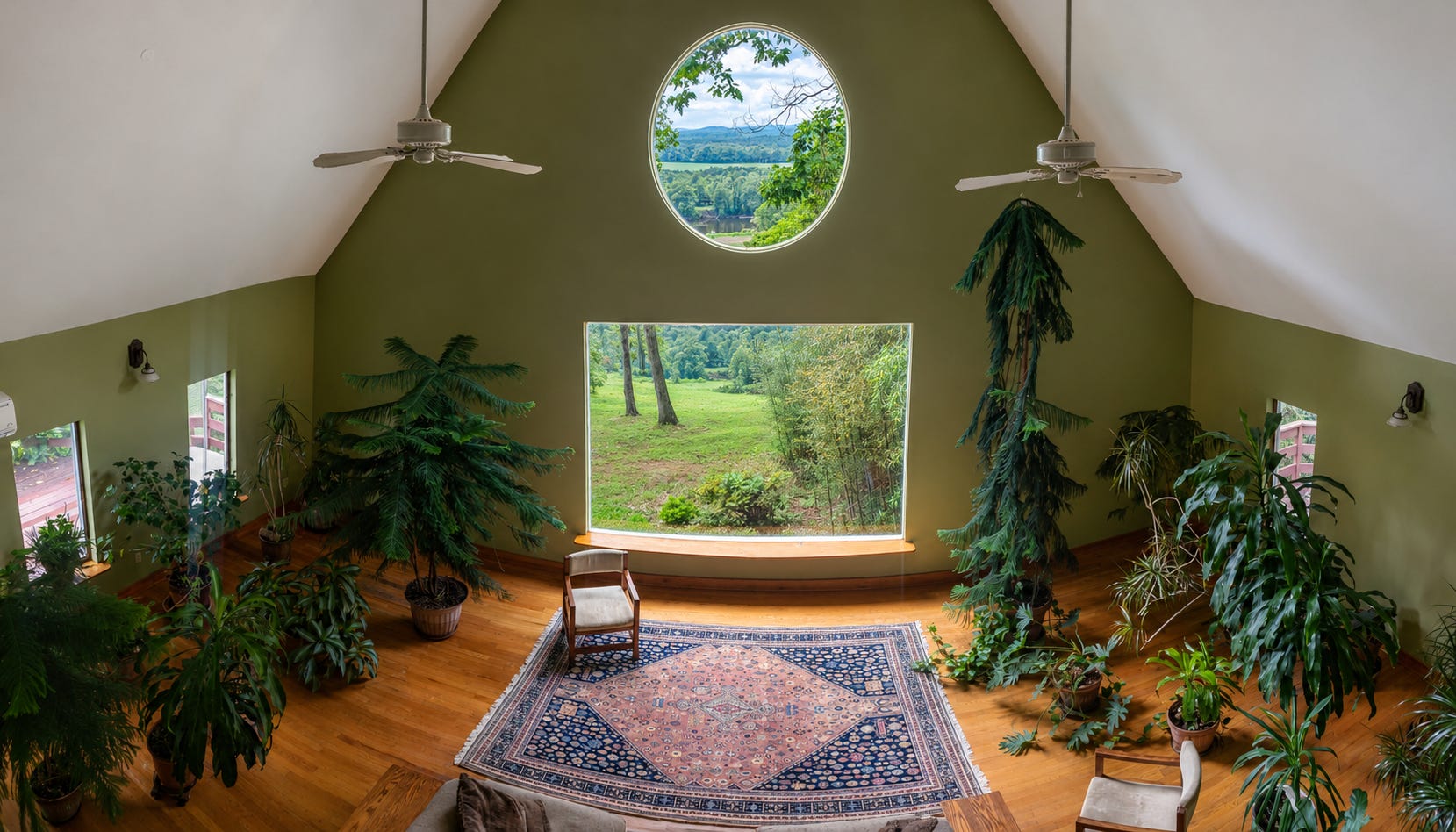
Riverview Spa, view from the bedroom.
The Sailboat
Panchakarma — pañcha (five), karma (actions) — is the Ayurvedic protocol for clearing what has accumulated in the body and mind over years of incomplete digestion: incomplete food, incomplete sleep, incomplete grief, incomplete weather. The premise is structural. We are open systems immersed in cycles — daily, seasonal, lifelong — and when we run consistently out of phase with those cycles, the residue (Ayurveda calls it āma, “the uncooked”) settles into whichever channel of the body is already weakest. Eventually — sometimes a long while later — that channel speaks up.
The five actions of Panchakarma are not all done on every patient. What is universal is the gesture: the body is saturated, internally and externally, with medicated oils across several days; the oil draws the āma out of tissue and into the digestive tract; the body, now properly lubricated, is invited to release it.
This is not detox in the Instagram sense. It’s closer to decommissioning a long-running pot of stew so the kitchen can be reset.
Dr. Sullivan trained at the Ayurvedic Hospital in Coimbatore and did advanced studies in Pune. He is also a chiropractor and a yoga teacher of forty-five years. The compound that comes out of those three modalities is, I’m finding, hard to compare to anything else.
On the Table
The treatment room has a wooden table and two therapists, which is how serious abhyaṅga is supposed to be done — four hands moving in synchrony so the body never feels asymmetric, never has time to brace. The oil is herbalized, warm, lavishly applied. The work is firmer than the boutique-spa version of Ayurvedic massage. Marma points get pressed. The scalp is included as the main event rather than the garnish; śirobhyaṅga, “head massage,” is not an add-on but, in Dr. Sullivan’s reading, the gateway. If you relax the head, you relax the senses, and you go in further. He’s right. I went in further.
After the oil, the steam. The pores open, the oil sinks deeper, the āma is coaxed toward the surface. After the steam, śirodhāra — a continuous stream of warm oil poured across the forehead in a slow horizontal sweep that feels, after a few minutes, like the nervous system being gently unplugged and re-plugged into a quieter outlet. Vāta is the elemental quality of dry, cold, mobile wind, and it governs the nervous system. Oil — heavy, warm, stable — is its precise opposite. Śirodhāra is the geometry of opposites applied to the part of you that has been doing the thinking for too long.
The Cosmology Behind the Oil
Lunch, then rest, then a long conversation. This is where Panchakarma turns out to be not just a treatment but a teaching.
Ayurveda, like its sister-science yoga, begins from the pañcha-mahābhūtas — the five great elements of space, air, fire, water, and earth — and traces them, in pairs, into the three doṣas that organize a human body: vāta (air + space, governing movement and the nervous system), pitta (fire + a little water, governing metabolism and transformation), and kapha (water + earth, governing structure and lubrication). Each of us is born with a particular ratio of the three, the prakṛti, set at the moment of conception. Each of us also moves through life, the day, and the year in a constant negotiation with their fluctuation. Like the surfer and the wave, Dr. Sullivan says. Nobody’s going to stop the wave. We just want to stay balanced on it.
Most chronic disease, by Ayurvedic reckoning, is a slow-motion drama in six stages — āma accumulates, āma aggravates, āma relocates to the body’s weakest channel, āma settles in, disease manifests, disease becomes systemic. We tend to spend our forty-thousand-day surf session paying attention only at stage five. By then the wave is on top of us.
The intervention point, Ayurveda insists, is much earlier. It is in the design of the day.
The Day, the Year, the Lifetime
There’s a Thomas Jefferson story. Someone once asked the old polymath how he managed to be an architect, statesman, horticulturalist, and inventor inside a single lifetime, and Jefferson said: I have never been caught in bed with the sun up. He kept a clock by the bed for the express purpose of not being.
Ayurveda would call this dinacharyā — the daily routine matched to the doshic clock. The hours before sunrise belong to vāta: light, clear, prayerful — the bhakti hour, when, in Swami Satchidananda’s phrase, the wall between us and the divine is thinnest. Sunrise to mid-morning is kapha: damp, slow, heavy — a time for movement, not sleep. Mid-morning to early afternoon is pitta: digestive fire at its peak, which is why the main meal should be at noon and not, as the modern day insists, at 8 p.m. Late afternoon swings back into vāta, which is why everyone in an office at 3:30 reaches for caffeine and chocolate; the wind has picked up again and they’re trying to use stimulants to steady the boat. After sunset, kapha again, slow and sleepy. Late night, vāta once more, which is why people who stay up past midnight tend to be wired, wide, and rarely well.
The pattern scales up. The year has its doshic seasons — kapha in spring (greens, fasting, the cleansing traditions of every continent), pitta in summer (cucumbers and mint, the cooling things the body asks for), vāta in fall and early winter (warmth, fats, root vegetables, what Grandma did).
A life has its doshic phases — kapha in childhood (we grow, we sleep, we accumulate tissue), pitta in adulthood (we burn, we build, we burn out), vāta in age (we dry, we thin, we lighten). The aging process, Ayurveda will tell you plainly, is the drying out of the body. The intervention is oil. This is why snehana — oilation — is regarded not merely as therapy but as rasāyana, rejuvenation. The Bible has its anointings for the same reason. The language is older than any one tradition.
It is also why what’s happening this week is not, despite the brochure, primarily a spa experience. It is a re-introduction of oil — into a body, into a nervous system, into a household, into a life — at a scale most modern people have never received.
A Class for One
By five o’clock the day has reset. Dr. Sullivan opens the evening with a brief chiropractic adjustment — the chiropractic and the Ayurvedic share more than a building here; they share a working theory that structure and function are one circuit, and that the spine is its wire — and then he teaches a private yoga class on the floor of his clinic.
The warmup is thorough. The alignments are exact. He coaches the postures the way a good editor coaches a sentence — never asking for force, always asking for clarity. Chair pose with the arms straight out and the wrists relaxed, the way Swamiji teaches it, weight settled into the heels. Locust pose with the hands tucked beneath the body, thumbs together, chin extended along the floor; before lifting, just hang there for a second. Relax into the pose. Headstand (“king of asanas”) built up in the corner of the room one minute at a time, until the body remembers the position to move off the wall.
What surprises me is the closing relaxation. He guides a long śavāsana — a head-to-toe scan, a slow inventory of the breath, an instruction to rest as the silent witness, just watch the gentle inhalation, exhalation — that turns out to be its own teaching. Seventy-five percent of meditation, he says afterward, is just being able to sit comfortably. The āsanas exist to make the sitting pose easier; once the body has been quieted enough to be forgotten, the mind can follow. “Meditation is like a muscle. The more you use it, the bigger and better it gets.”
I have been a yoga teacher for years and have rarely had a teacher of my own who blends skeletal precision with this much devotional ease. That combination is, in fact, the point. The body is the instrument through which the spirit can be reached. Treat the instrument well.
What Crosses Mountains
Later, over chai, the geography opens up. Ayurveda did not stay in India. When it crossed the Himalayas into China, the marma points of Ayurveda became the acupuncture points of Chinese medicine — the underlying map of energy did not change; the vocabulary did. When it traveled west through Persia into Greece, the three doṣas became the endomorph, mesomorph, and ectomorph body types of Hippocratic constitution. Kapha, pitta, vāta, in other clothes.
Dr. Sullivan tells me about an Indian physician who once visited his chiropractic school as part of a WHO exchange, watched him work on a patient, and said, “In our country we have yoga. You do it for people.”
The story running the other direction is also, partly, a story of erasure. Before antibiotics, he says, old-time American chiropractors kept steam boxes in their offices to bring the body’s core temperature high enough, for long enough, to clear bacterial and viral infections. Kellogg, the sanatorium movement, the whole grammar of natural healing — there was a serious American practice in place. However, you can’t patent herbs or plants. The medical schools became pharmaceutical factories; the steam boxes went out with the trash. In India the same suppression had happened earlier and more violently: the British forbade Ayurveda, jailed and killed its physicians, closed the colleges. The serious revival did not begin until Gandhi, in the 1920s.
This is not nostalgia. Dr. Sullivan has chosen his practical compound — chiropractic plus Ayurveda plus yoga — for the same reason a good cook keeps three knives on the counter. Each does something the others can’t, and each remembers what the others have forgotten.
The doctor informs me one more etymology. The Sanskrit word for the oilation that is the spine of this entire week is snehana. It comes from sneha — affection, love. When you’re covered in oil, he says, it’s like being back in the womb.
A medicine whose central act, the slow daily oiling of the body across five days, is named after love. The boat is bigger and more beautiful than I thought.
What’s Ahead
Tomorrow is virecana — the purge. The ghee I’ve been drinking each morning is the oil that will carry the loosened āma downward and out. The day after, treatment again, and another. Then basti — two final days, where medicated oil is delivered through the colon, which Ayurveda considers the seat of vāta and therefore the most leveraged point in the entire system. The scriptures say bastis are fifty percent of the treatment, Dr. Sullivan tells me. Because it’s all about the vāta. The wind, and the proper flame.
Then I’ll get out of the boat.
An Old Boat on a New River
A few hours after this morning’s session, walking the lane back toward the river, I found myself thinking about scale. This medicine is five thousand years old; I am one body; we are nearly eight billion. A traditional Panchakarma is, by design, individual — prakṛti is unrepeatable, dosage is bespoke, the pulse under each wrist tells a different story.
But the cosmology behind it is not individual. It is ecological. It begins from the same five elements that make a forest, a watershed, a river basin. The body it heals is continuous with the body of the earth it heals on. Āma in a person is what runoff is in a creek, what particulate is in air, what unprocessed grief is in a town: material that didn’t get digested and is now lodged where it doesn’t belong.
I came to Riverview Spa to begin a personal protocol. I’m leaving today’s session suspecting that the same protocol, scaled to a community — its daily rhythms, its seasonal foods, its design of work and rest — is one of the most underused public-health interventions available to anyone willing to take ancient cosmology as seriously as we currently take blood panels.
That, however, is an essay for later in the week.
For now: I’m on the boat. The wind is doing what it wants. There’s my home-made medicinal ghee in the kitchen and oil in the room and a small clinic in Buckingham County, Virginia, where a doctor showing me, one day at a time, what it looks like to be properly cared for by a medicine older than my country.
As I left the clinic, it began to rain — the sky, on cue, doing its own oilation.
om shanti